
There is no fixed number of missed mortgage payments in Ontario before power of sale. Legally, your lender can send a notice of sale once a payment is 15 days late. It must then wait at least 35 more days to sell. Many lenders act after two or three missed payments, but you should not count on extra time.
If you are behind right now, you are not the only one, and you have not run out of options. This guide shows what happens after each missed payment, how to get help, and how to protect your equity if selling becomes the best path.
Key takeaways
- The law sets a floor, not a count: 15 days of default before a notice, then at least 35 days before a sale.
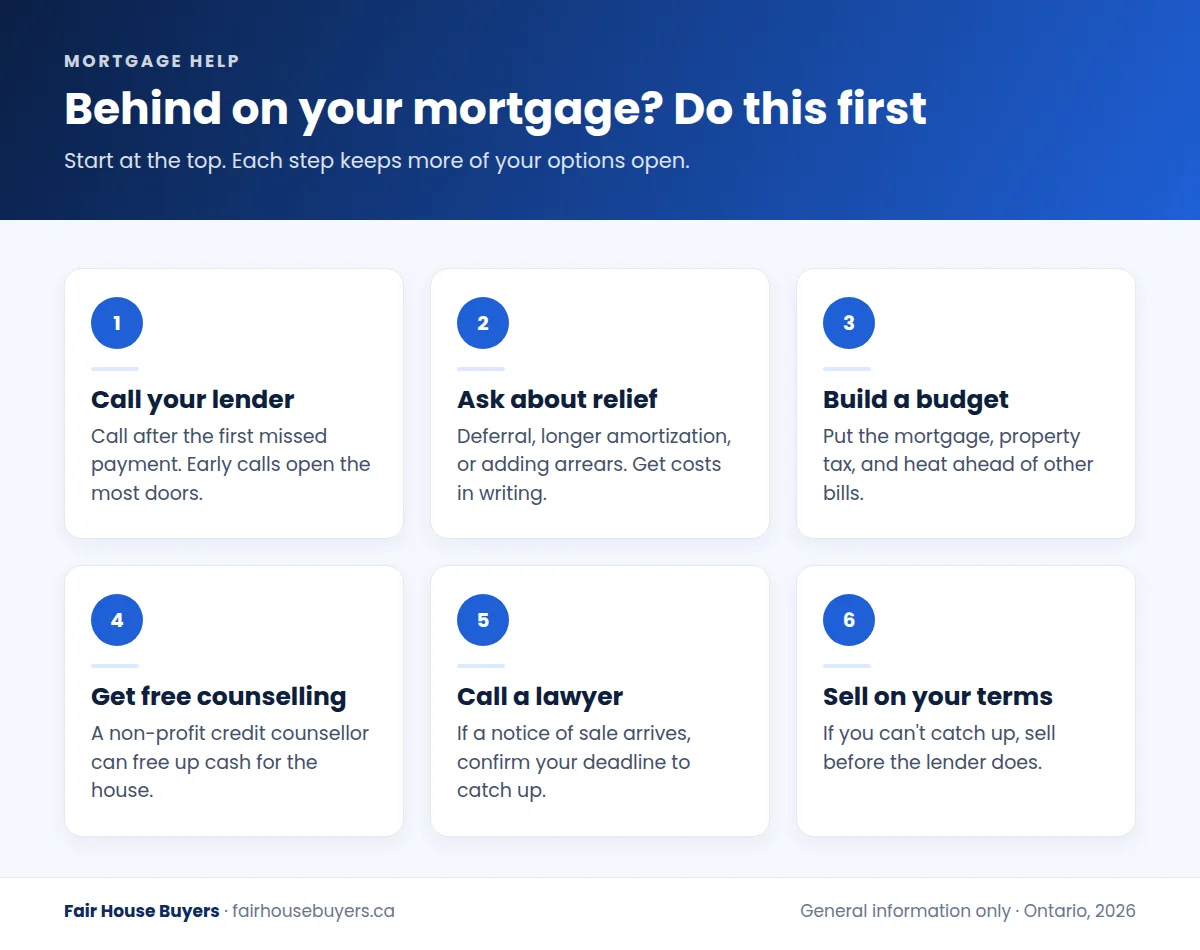
- Call your lender after the first missed payment. Early calls open the most doors.
- Ask about relief such as a deferral, a longer amortization, or adding the arrears to your balance, and get the cost in writing.
- A free, non-profit credit counsellor can help you free up cash for the mortgage.
- If you can’t catch up, selling on your own terms usually beats a lender-run sale.
How many missed mortgage payments before power of sale in Ontario?
The Ontario Mortgages Act doesn’t count payments. Instead, it counts days. Once you are at least 15 days in default, the lender may send a formal Notice of Sale Under Mortgage. Then it must wait at least 35 days before it sells.
In real life, most lenders start with calls and letters, not a notice. Many wait until two or three missed mortgage payments in Ontario before they bring in lawyers. But every lender and every contract is different, so the safe plan is to act as if the clock started on day one.
Watch out: Don't let the letters pile up
Unopened mail won’t slow anything down. In fact, ignoring your lender is the fastest way to lose your options, because they can’t offer help to someone they can’t reach.
What happens after missed mortgage payments in Ontario
First, here is how things often unfold. Only the 15-day and 35-day periods come from the law. The rest is typical, so treat it as a guide.
| When | What often happens | What you can do |
|---|---|---|
| Days 1 to 15 | A missed or bounced payment, plus an NSF or late fee. Your lender calls or writes. | Call back right away and explain what happened. |
| 15+ days late | The lender now has the legal right to send a notice of sale. | Ask about relief options and a repayment plan. |
| 1 to 3 months | More missed payments, collection calls, and damage to your credit. | Talk to a credit counsellor and a lawyer. |
| After a notice | At least 35 days before the lender can sell. | Reinstate, refinance, or sell on your terms. |
| Often 3 to 6+ months | The lender gets possession and sells the home. | Any surplus after debts and costs comes to you. |
For the full legal process, read our guide to the power of sale timeline and your rights. The key point is simple: you can pay the arrears plus the lender’s costs at any time before the sale to put the mortgage back in good standing.
Why missed mortgage payments are rising in Ontario
Many people who bought or renewed when rates were low now face much higher payments. So if you have missed mortgage payments in Ontario lately, it is not a personal failing. The numbers show a real squeeze across the province.
0.32%
of Ontario mortgages were in arrears in May 2026, above the national 0.29% (CBA data)
4 years
of quarterly rises in Ontario 90+ day mortgage delinquencies (Equifax, Q2 2026)
0.34%
Toronto arrears rate forecast by the end of 2026, up from 0.076% in Q3 2023 (CMHC)
What to do after missed mortgage payments in Ontario
These steps are in order for a reason. The first ones help you keep your home, while the later ones protect your equity if you can’t.
Call your lender now. The Financial Consumer Agency of Canada says to contact your lender as soon as you have trouble paying.
Ask about relief options. Get each option’s monthly payment and total cost in writing before you agree.
Build a bare-bones budget. List what must be paid each month, and put the mortgage, property tax, and heat first.
Talk to a credit counsellor. A non-profit counsellor can help you deal with cards and loans so more cash goes to the house.
Call a lawyer if a notice arrives. A real estate lawyer can confirm your deadline and your right to reinstate.
Mortgage relief options, compared
FCAC lists several mortgage relief options that lenders may offer. Each one eases the pressure now, but most cost more over time.
| Option | How it works | The trade-off |
|---|---|---|
| Payment deferral | Skip or pause payments for a short time | Interest keeps adding up |
| Longer amortization | Spread the balance over more years | Lower payment, more total interest |
| Add arrears to the balance | Missed payments join the loan | You pay interest on the arrears |
| Interest-only payments | Pay interest but no principal for a while | Your balance doesn’t shrink |
| Repayment plan | Pay a bit extra each month until caught up | Higher payments for a set time |
For example, say your payment is $2,800 and you missed two. That is $5,600 in arrears. On a six-month repayment plan, you would pay about $933 extra a month, so roughly $3,733 in total each month until you catch up.
Good to know: The Canadian Mortgage Charter
Under the federal Canadian Mortgage Charter, lenders are expected to offer at-risk borrowers help such as temporary amortization extensions and waived relief fees. It is worth naming the charter when you call.
What if you can’t catch up?
Sometimes the numbers just don’t work, even with relief. That is hard to face, especially after months of trying. Still, making a plan now gives you far more control than waiting for the lender to act.
Refinance or borrow against your equity
If you have enough equity, a new lender may pay off the arrears or the whole mortgage. Private lenders can also move fast. However, they often charge high rates and fees, so only use one as a short bridge with a clear exit.
Look at a consumer proposal
A Licensed Insolvency Trustee can explain whether a consumer proposal fits. For example, it can reduce unsecured debts like credit cards, which may free up cash for the mortgage. That said, it affects your credit, so get the full picture first.
Sell on your own terms
If keeping the home isn’t realistic, selling before the lender does protects your equity. That way, you avoid the lender’s extra legal fees and sale costs. You also choose your moving date.
See what you would walk away with
Compare listing with an agent against a cash sale, side by side. You’ll get a free PDF report by email.
With time on your side, listing with a good agent usually gets the highest price. But when you are months behind, a quick, certain sale can matter more. Our guide on cash offers vs. listing with a realtor covers the trade-offs, and how fast you can close in Ontario explains the timing.
A cash offer is usually below full market value. Still, we’ll always say so plainly. We make a written offer, usually within 24 hours, with no fees, no repairs, and a closing date you choose.
Protecting yourself after missed mortgage payments in Ontario
When you have missed mortgage payments in Ontario, a few habits make a big difference:
- Keep a paper trail. Write down every call with your lender, including the date, the name, and what they said.
- Get offers in writing. After all, a promise on the phone won’t help you once the file moves to a lawyer.
- Watch for scams. Be careful with anyone who asks for upfront fees or wants you to sign over your title. See our red flags guide for cash buyers.
- Keep your home insured. Missing home insurance can put you in default too.
This article is general information, not legal or tax advice. Talk to a real estate lawyer or accountant about your situation.
Frequently asked questions
There is no set number. Under the Mortgages Act, a lender can send a notice of sale once you are 15 days in default, then must wait at least 35 days to sell. Many lenders wait for two or three missed mortgage payments in Ontario, but that is their choice. Call your lender after the first one.
Your lender will usually charge fees, call, and send letters. Your credit can take a hit. If you stay behind, the lender can send a notice of sale and, after the notice period, sell the home. You can stop this by catching up, getting relief, refinancing, or selling on your own terms first.
Outright forgiveness is very rare. But lenders often agree to relief, such as a payment deferral, a longer amortization, or adding missed payments to your balance. These lower the pressure for now, but they usually raise your total cost. Ask for every option in writing before you decide.
The legal minimum is about 50 days: 15 days of default plus a 35-day notice period. In practice, it often takes three to six months or more. It depends on your lender, whether a court order for possession is needed, and how quickly the home sells.