
Power of sale in Ontario is how a lender sells your home without going to court after you fall behind on your mortgage. First, you must be at least 15 days in default. Then the lender sends a notice and must wait at least 35 days before selling. Until the sale, you can still stop it by catching up.
If you just got a notice, take a breath. You have more options than it feels like right now. This guide walks through the timeline, your rights, and every way to stop the sale, starting with the ones that let you keep your home.
Key takeaways
- A lender can’t send a notice of sale until your payment is at least 15 days late, and it can’t sell until at least 35 days after that notice.
- You can stop a power of sale by paying the missed payments plus the lender’s costs before the sale.
- Call your lender first. Ask about relief such as a payment deferral, a longer amortization, or adding the arrears to your balance.
- The whole process often takes three to six months or more, so every week you act sooner gives you more choices.
- If selling is the right call, selling on your own terms usually leaves more money in your pocket than a lender-run sale.
What does power of sale mean in Ontario?
When you take out a mortgage, you give the lender a legal claim on your home. That claim sits on your title until the loan is paid off. If you stop paying, the mortgage contract and the Ontario Mortgages Act let the lender sell the home to get its money back.
Most lenders use power of sale in Ontario because it is faster and cheaper than going to court. You still own the home until it closes. So you keep the right to sell it yourself, refinance, or catch up.
Power of sale vs. foreclosure
People often use the two words as if they mean the same thing. But they work quite differently, and the gap matters for your equity.
| Feature | Power of sale | Foreclosure |
|---|---|---|
| Court process? | No, it runs on notices | Yes, the lender must sue |
| How common in Ontario | Very common | Rare |
| Who ends up with the home | A buyer the lender finds | The lender takes title |
| Leftover equity | Goes to other creditors, then to you | You can lose it |
| Speed | Often three to six months | Usually slower |
The power of sale timeline in Ontario, step by step
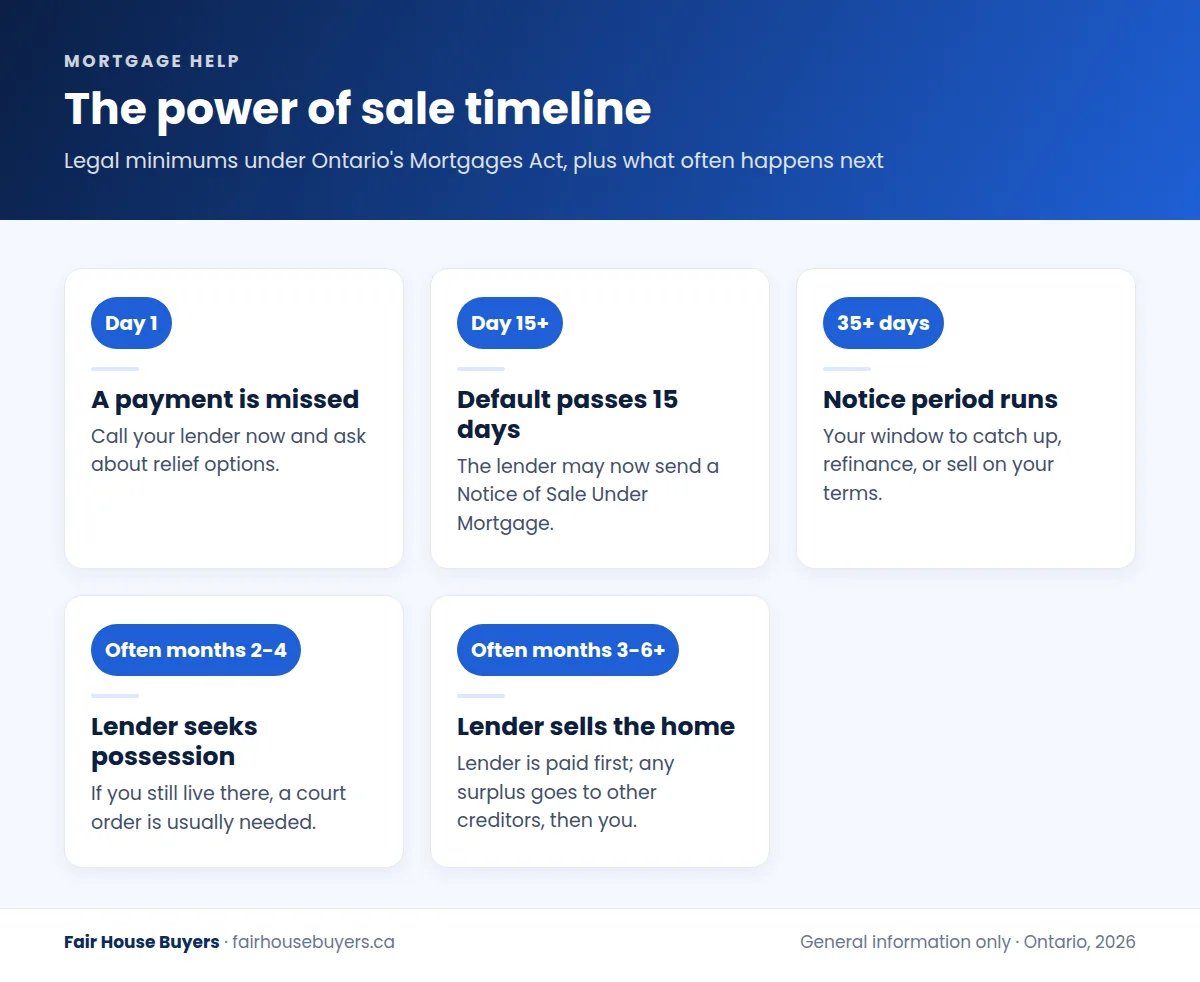
The law sets two firm minimums for a power of sale in Ontario: 15 days of default before notice, then 35 days of notice before a sale. Everything else depends on your lender, the courts, and the market. For that reason, the full process often runs three to six months, and sometimes longer.
You miss a payment. Your lender will usually call or send letters and may charge late or NSF fees. This is the best time to talk to them.
The default passes 15 days. Once you are at least 15 days behind, the lender may send a formal Notice of Sale Under Mortgage to you and anyone else with a claim on title.
The notice period runs at least 35 days. During this window, the lender generally can’t take other steps to enforce the mortgage. It is your window to reinstate, refinance, or sell.
The lender seeks possession. If you still live in the home, the lender usually needs a court order before the sheriff can change the locks.
The lender lists and sells. Lenders are expected to take reasonable care to get a fair market price, often through a regular listing.
The sale closes. The lender pays itself, its legal fees, and its costs first. Then any surplus goes to other creditors, and then to you.
Watch out: Don't wait for the last day
You can reinstate at any time before the sale. But once the lender signs a firm deal with a buyer, that right may be gone. Act early, while every door is still open.
Your rights during a power of sale in Ontario
A notice feels final, but the law gives you real protection.
- Proper notice. The lender must give written notice after at least 15 days of default and wait the full notice period before selling.
- The right to reinstate. Under section 22 of the Mortgages Act, you can pay the arrears plus the lender’s costs before the sale. Then the mortgage carries on as normal.
- A pause on other action. While the notice period runs, the lender generally can’t take further enforcement steps.
- The right to sell first. You still own the home, so you can sell it yourself, as long as the sale pays off what you owe.
- The right to any surplus. If the lender’s sale brings in more than the debts on title, the extra comes to you.
How to stop a power of sale in Ontario
There is no single right way to stop a power of sale in Ontario. So start with the options that keep you in your home, and move down the list only if you need to.
1. Call your lender before anything else
The Financial Consumer Agency of Canada says to contact your lender as soon as you have trouble. Lenders would usually rather work out a plan than sell a home. Also, a forced sale costs them time and legal fees too.
Ask about the mortgage relief options FCAC lists: a short payment deferral, a longer amortization, adding the arrears to your balance, or interest-only payments for a while. Each one can raise your total cost, so ask for the numbers in writing.
The federal Canadian Mortgage Charter also sets out what lenders are expected to offer borrowers at risk. That includes temporary amortization extensions and waived fees for relief.
2. Pay the arrears to reinstate the mortgage
Reinstating means paying what you missed plus the lender’s costs. For example, say your payment is $3,200 a month and you missed three. You would need $9,600, plus any late fees and the lender’s legal costs so far.
Ask the lender for a written reinstatement statement, so you know the exact amount and the deadline.
3. Refinance or bring in a second lender
If you have good equity, a new lender may pay out the old one. Private lenders move fast, but they often charge high rates and fees. So treat a private loan as a short bridge with a clear plan, not a long-term fix.
4. Get free advice on your other debts
A non-profit credit counsellor can help you build a budget and deal with credit cards or loans. That can free up cash for the mortgage. A Licensed Insolvency Trustee can also explain a consumer proposal, which can cut unsecured debts while you keep paying the house.
0.32%
of Ontario mortgages were in arrears in May 2026, up from a year earlier (CBA data)
0.076% to 0.261%
rise in the Toronto arrears rate from Q3 2023 to Q3 2025 (CMHC)
35 days
was the average time on market for GTA listings in August 2026 (TRREB)
So you are far from alone. The numbers also show why timing matters: an average GTA listing takes about five weeks to sell, and closing takes longer.
5. Sell the home yourself before the lender does
If you can’t catch up, selling on your own terms is often the next best step. You control the price, the timing, and the move. Plus, you avoid the extra legal fees and costs that a lender-run sale adds to your debt.
Facing a notice of sale?
We can give you a written cash offer, usually within 24 hours, and close in as little as 7 days. There are no fees or commissions, and no pressure to say yes.
Get my cash offer →or call 905-497-5534
Listing vs. a cash sale when time is short
If you have a few months, listing with a good agent will usually get you the highest price. However, a notice period can be as short as 35 days, and a normal listing plus closing often takes longer. In that case, speed and certainty can be worth more than top dollar.
| Factor | List with an agent | Sell to a cash buyer |
|---|---|---|
| Price | Usually highest | Usually below full market value |
| Time to close | Often 30 to 90 days after an offer | As little as 7 days |
| Commission | Yes, negotiable | None |
| Repairs and showings | Often needed | None, sold as-is |
| Risk of a deal falling through | Financing and conditions | Lower, no mortgage approval needed |
Be wary of anyone who pressures you to sign fast. Read our guide on red flags to watch for with cash buyers, and compare any offer with the real cost of selling in Ontario through a listing.
What happens after a power of sale?
When a power of sale in Ontario closes, the money goes out in a set order. The lender takes the mortgage balance plus its legal fees, sale costs, and interest. Next come other creditors on title, such as a second mortgage. Finally, anything left over goes to you.
If the sale brings in less than you owe, the lender can still come after you for the shortfall. A power of sale can also hurt your credit for years. That is why selling early, while you still have equity, usually protects you better than waiting.
Tip: Get a lawyer's eyes on the notice
A real estate lawyer can check that the notice and dates are correct. They can also tell you exactly how long you have to reinstate or sell.
Your next step
Start with a call to your lender today, and write down what they offer. Then book a free chat with a credit counsellor. If selling makes sense after that, you can see how our process works or read about help for Toronto homeowners facing a lender sale.
This article is general information, not legal or tax advice. Talk to a real estate lawyer or accountant about your situation.
Frequently asked questions
After you are at least 15 days behind, your lender can send a notice of sale. It must then wait at least 35 days. If you don’t catch up or sell first, the lender takes steps to get possession, lists the home, and sells it. It pays itself first, then other creditors, and any surplus goes to you.
The legal minimum is about 50 days: 15 days of default plus a 35-day notice period. In practice, a power of sale in Ontario often takes three to six months or longer. The pace depends on your lender, whether a court order for possession is needed, and how fast the home sells.
There is no set number. A lender can send a notice of sale once a payment is 15 days overdue. Many lenders wait until you have missed two or three payments, but you should not count on that. Call your lender after the first missed payment to ask about relief options.
Outright forgiveness is very rare. However, lenders often agree to relief, such as a payment deferral, a longer amortization, or adding missed payments to your balance. These can lower your payment for a while, but they usually raise your total interest cost. Ask for every option in writing.