
How fast can you close on a house in Ontario? With a cash buyer, you can close in as little as 7 days, because there’s no mortgage approval to wait for. A typical sale to a buyer with a mortgage closes 30 to 90 days after the offer is firm, and about 60 days is common.
That’s only the closing period, though. If you list, you also need time to prep, show the home, and find a buyer. This guide walks through each timeline, what slows things down, and when a fast close is worth it.
Key takeaways
- Most Ontario closings land 30 to 90 days after a firm deal, often around 60 days.
- A cash sale can close in as little as 7 days, since there’s no lender, appraisal or financing condition.
- Your real estate lawyer handles title, payouts and registration, so hire one early.
- Estates, liens, tenants and spousal consent can all slow a closing, whatever the buyer.
- Speed usually costs something, so compare your net from each route before you choose.
35 days
average time on market for GTA listings (TRREB, Aug 2026)
30–90 days
typical Ontario closing period after a firm deal
As little as 7 days
to close a cash sale with Fair House Buyers, or on the date you choose
How fast can you close on a house when the buyer has a mortgage?
Most buyers need a mortgage, and that shapes how fast you can close on a house. Because of that, the traditional route has several stages, and each one takes time. So here is a realistic picture for a typical GTA home.
| Stage | Typical time | What happens |
|---|---|---|
| Prep and listing | 1–3 weeks | Cleaning, repairs, photos and pricing |
| On the market | About 5 weeks on average | Showings, offers and negotiation |
| Conditional period | Often 5–10 days | Buyer’s inspection and mortgage approval |
| Closing period | 30–90 days | Lawyers prepare title, funds and documents |
In August 2026, GTA listings sold in 35 days on average, according to TRREB’s Market Watch. However, that figure jumps to 49 days when you count homes that sellers pulled and relisted. Then you add the closing period. Ontario closings typically run 30 to 90 days, often about 60.
So from “for sale” sign to money in hand, a listed home often takes three to five months. It can also move faster in a hot pocket of the market. However, it can drag on if the price is off or a deal falls through.
How fast can a cash buyer close on a house?
A cash buyer can close on a house fast because it skips the slowest parts. There’s no mortgage approval, no appraisal, and no financing condition to clear. As a result, the timeline depends mostly on the lawyers.
With Fair House Buyers, you usually get a written cash offer within 24 hours. You can close in as little as 7 days, or on the date you choose. There are also no showings, no repairs, and no commission.
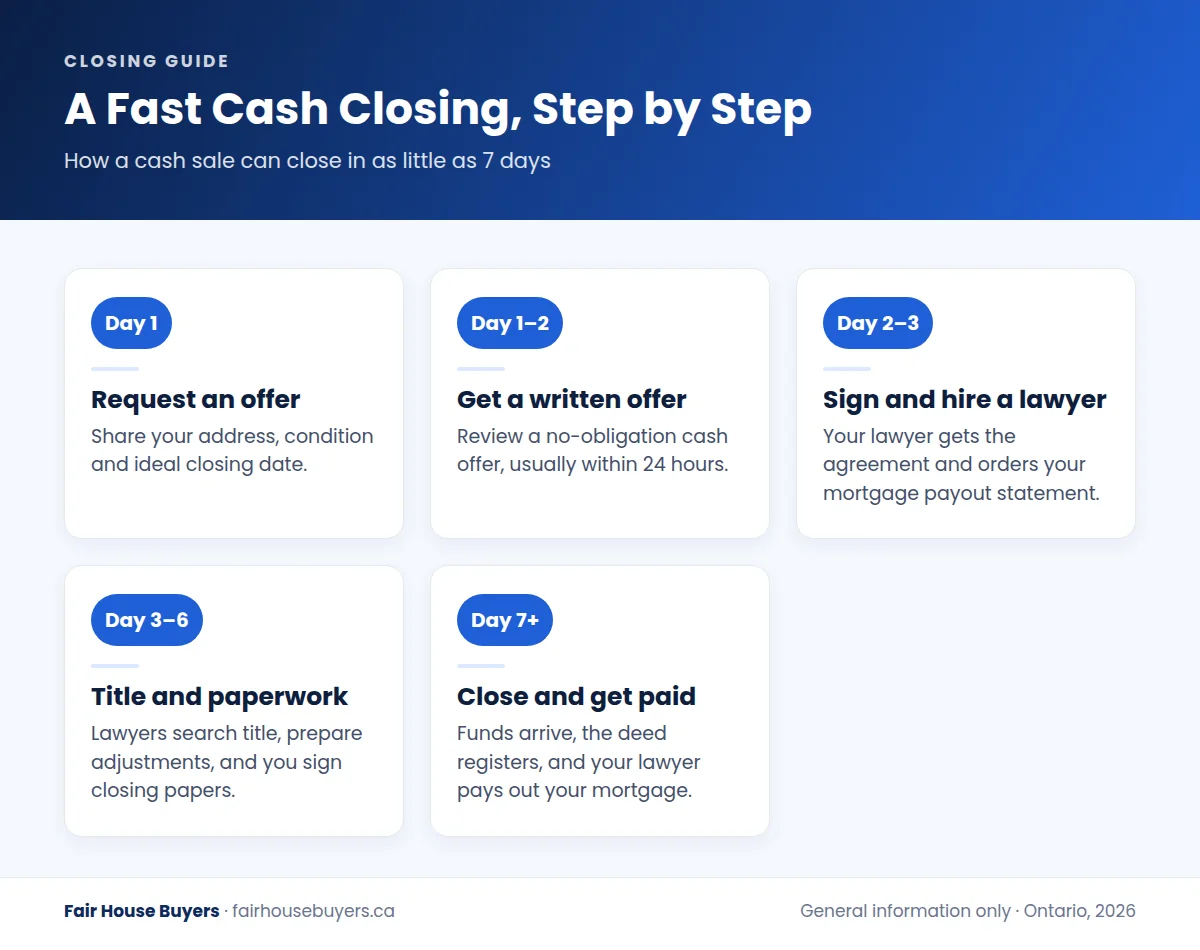
Keep in mind that “as little as 7 days” assumes clean title and quick paperwork. For example, if you have a mortgage, your lender must send a payout statement first. Your lawyer also needs time to search title and prepare the deed.
Tip: Order your payout statement early
Ask your lender for a mortgage payout statement as soon as you sign. It shows your balance, interest, and any penalty. A late statement is one of the most common reasons a quick close slips.
What happens between signing and closing
Whatever the buyer, your real estate lawyer does most of the closing work. In Ontario, only lawyers can register most title transfers electronically, as the province’s land registration bulletin explains. So even a fast cash sale needs a lawyer.
Sign the agreement. Send the signed agreement of purchase and sale to your lawyer right away.
Title search and payout. Your lawyer checks title for liens and asks your lender for a payout statement.
Statement of adjustments. Your lawyer splits property taxes and other costs between you and the buyer up to closing day.
Sign the closing papers. You sign the deed and other documents, usually a few days before closing.
Close and hand over keys. The buyer’s funds arrive, the deed registers, and your lawyer pays out your mortgage.
The Financial Consumer Agency of Canada’s guide to selling a home lists the costs you’ll see at this stage. These include legal fees, the statement of adjustments, and a mortgage discharge fee.
Need to close on your timeline?
Tell us about your home and your ideal date. We’ll send a written, no-obligation cash offer, usually within 24 hours.
Get my cash offer →or call 905-497-5534
What can slow down a fast close on a house?
Even when you want to close on a house fast, some delays have nothing to do with the buyer. If any of these apply to you, build in extra time, even with a cash sale.
- Probate. Estates that include real estate normally need probate, as Ontario’s guide to administering an estate notes. You can often sign a deal first, but closing usually waits for the certificate. Our guide to selling an inherited home in Ontario covers this.
- Mortgage penalties. Breaking a mortgage early can mean a prepayment penalty. It’s usually the higher of three months’ interest or the interest rate differential, according to the FCAC’s guide to prepayment penalties.
- Liens and title issues. Your lawyer must clear unpaid contractor liens, a second mortgage, or old title errors before closing.
- Tenants. A buyer who wants to move in must give a tenant proper notice. That notice is at least 60 days under Ontario’s rules for a purchaser’s own use.
- Spousal consent. A married spouse must usually consent to the sale of the family home, even if only one name is on title.
- Power of sale. If your lender has started enforcement, timing matters. See what power of sale means in Ontario.
Is a fast close always the best choice?
Not always. A fast close on a house is great when you face a deadline, a costly carrying bill, or a home you can’t manage. But speed usually comes at a price, because a cash offer is almost always below full retail value.
On the other hand, a longer close can help you, too. It gives you time to find your next home and plan the move. That’s why a good cash buyer should let you pick the date, whether that’s next week or three months away.
If you have time and your home is in good shape, listing will often net you more. To see the gap, compare a cash offer against listing with a realtor, and review the full cost of selling in Ontario.
How quickly do you get your money after you close?
First, on closing day, the buyer’s funds go to your lawyer. Your lawyer then pays off your mortgage and any other debts on title. After that, they send you the balance, often the same day or within a few business days.
If you need the money fast, ask your lawyer how they send funds and how long it takes. Also confirm that your ID and banking details are ready before closing day.
Good to know: Plan your move around the date
Book movers and utility changes as soon as your deal is firm. In a fast close, those small tasks can be the tightest part of the schedule.
Next step: pick the close that fits your life
So, how fast can you close on a house? When you need speed, a cash sale can close in as little as 7 days. But if you want top dollar and have time, a listing with a 30 to 90 day close may suit you better.
Then, if a fast, certain sale fits your plans, see how our process works or request an offer below.
This article is general information, not legal or tax advice. Talk to a real estate lawyer or accountant about your situation.
Frequently asked questions
A cash offer can close in as little as 7 days in Ontario, because there’s no mortgage approval, appraisal, or financing condition. The main steps left are the lawyers’ title search, the mortgage payout statement, and signing the closing papers. Estates, liens or tenants can add time. A good cash buyer will also let you choose a later date.
Most Ontario sales close 30 to 90 days after the deal is firm, and about 60 days is common. That’s on top of the time it takes to find a buyer, which averaged 35 days in the GTA in August 2026. A cash sale with clean title can close much faster, in as little as 7 days.
On closing day, the buyer’s funds go to your real estate lawyer. Your lawyer pays off your mortgage and any other debts on title, then sends you the balance. That often happens the same day or within a few business days. Ask your lawyer early how they release funds so you can plan.
In practice, yes. Only lawyers can register most title transfers electronically in Ontario, so you need one to close. Your lawyer also reviews the agreement, searches title, pays out your mortgage, and prepares the statement of adjustments. Seller legal fees typically run roughly $1,000 to $2,500 plus HST and disbursements.