
Yes, most cash home buyers are legit. They’re real businesses or investors that buy homes as-is and close through lawyers, like any other Ontario sale. But the industry has some bad actors too. So before you sign anything, learn the red flags that show whether cash home buyers are legit or just good at sales talk.
Below are 11 warning signs, grouped by when they tend to show up. You’ll also get the questions to ask and a quick way to check any buyer in Ontario.
Key takeaways
- A legit buyer always puts the offer in writing and wants you to use your own lawyer.
- You should never pay a fee, deposit or “admin charge” to get or accept an offer.
- Watch for bait prices that drop right before closing.
- Your deposit should sit in a lawyer’s or brokerage’s trust account, not the buyer’s pocket.
- If a deal feels rushed, slow down, because a fair offer will still be there tomorrow.
How legit cash home buyers actually work
A legit cash buyer makes money by buying below full retail value, then fixing, renting or reselling the home. That’s the honest trade. You give up some price, and in return you get speed, certainty, and no repairs or showings.
With legit cash home buyers, the paperwork looks just like a normal sale. You sign an Agreement of Purchase and Sale, the buyer pays a deposit, and then both lawyers handle closing. For the full process, see our guide to selling your home for cash in Ontario.
Trouble starts when a buyer skips those basics. So here are the warning signs to watch for, in the order you’ll likely meet them.
Red flags before cash home buyers make an offer
1. You can’t verify who they are
Legit cash home buyers are easy to look up. A real business has a legal name, a phone number someone answers, and people you can speak with. Search the company name along with “reviews” and “complaints.” If you can’t find any history at all, be careful before you share personal details.
2. They ask you to pay anything
You should never pay to get an offer, to sign one, or to “hold your spot.” Legit cash home buyers earn their money when they resell, not from sellers. In fact, an upfront “admin fee” or “processing deposit” is one of the clearest scam signals.
3. They push you to sign today
Lines like “this offer expires in an hour” are a tactic, not a real deadline. A fair buyer gives you time to call your lawyer and compare options. If they won’t, walk away.
4. The price sounds too good, sight unseen
Some buyers quote a high number over the phone to win the deal, then chip away at it later. Since a buyer needs to see the home to price it well, treat any big number made without a walkthrough as a teaser, not an offer.
Red flags in cash home buyers’ contracts
5. Nothing is in writing
In Ontario, a deal isn’t a deal until both sides sign a written agreement. Verbal promises about price, closing date or moving costs mean nothing unless they’re in the contract. So ask for the full agreement, not a one-page summary.
6. The deposit is tiny or goes straight to them
A deposit shows the buyer is serious. It should go into a lawyer’s or brokerage’s trust account, not the buyer’s own company. A token deposit, like $10 on a $700,000 home, gives them an easy exit and gives you almost no protection.
7. The contract is full of escape hatches
Watch for conditions like “subject to partner approval,” an inspection with no end date, or a financing condition from a so-called cash buyer. Each one lets them back out while your home sits off the market. By contrast, a solid cash offer has few conditions, and each one has a short deadline.
8. They dodge the question of who is buying
Some companies sign the deal and then assign it to another investor before closing. That can be fine when they disclose it and your price and date stay the same. However, it’s a red flag when they won’t say who will actually close or where the money comes from.
Want a straight answer on your home?
Get a written cash offer, usually within 24 hours, with no fees or commissions. Then show it to your lawyer and take your time to decide.
Get my cash offer →or call 905-497-5534
Red flags from cash home buyers near closing
9. They steer you away from your own lawyer
Every seller needs their own lawyer. After all, only lawyers can register most title transfers in Ontario’s electronic land registry. If a buyer says you don’t need one, or wants “their” lawyer to act for both sides, stop there.
10. The price drops at the last minute
This trick is called re-trading. The buyer finds a “surprise” problem a few days before closing and demands a big cut. They’re betting you’ve already packed and can’t start over. A fair buyer does their homework up front, so their price holds.
11. They want your title, keys or a power of attorney early
Never sign over title, hand over keys, or grant a power of attorney before closing. Also be wary of “rent it back, buy it back later” offers, especially when you’re behind on payments. These setups can strip your equity without a real, fair sale.
Watch out: Behind on payments? Know your rights
Under Ontario’s Mortgages Act, you can pay the arrears and costs at any time before a power of sale closes to put your mortgage back in good standing. So be wary of anyone who charges a fee to “save” your home. Our page on power of sale options explains your choices.
What legit cash home buyers always do
The good news is that honest buyers look alike. They’re open, patient and happy to put everything in writing. Here’s what to expect from them.
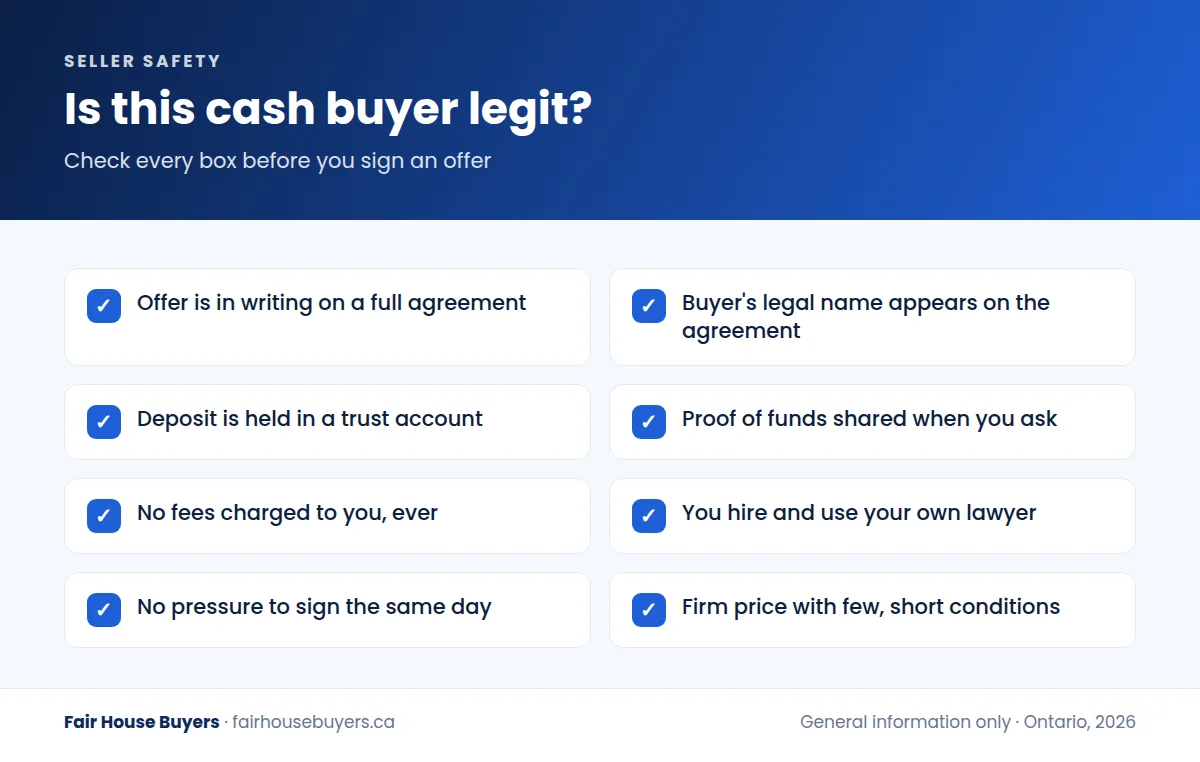
- Put the full offer in a written agreement with their legal name on it.
- Hold your deposit in trust with a lawyer or brokerage.
- Show proof of funds, such as a bank letter, when you ask.
- Charge you nothing: no fees, no commission and no surprise costs.
- Encourage you to hire your own real estate lawyer.
- Explain every condition and give each one a firm end date.
- Stand behind their price unless a truly hidden problem turns up.
Questions to ask cash home buyers
Ask these before you sign. A legit buyer will answer each one plainly, and in writing if you ask.
| Question | Why it matters |
|---|---|
| Whose name goes on the agreement as buyer? | You need to know who you’re dealing with and who closes. |
| Can you show proof of funds? | It confirms they can close without a lender. |
| Where will my deposit be held? | A trust account protects your money if the deal fails. |
| What conditions are in the offer, and when do they end? | Loose conditions let a buyer walk away late. |
| Could the price change before closing? | This flags re-trading risk early. |
| Will I pay any fees or costs to you? | The answer should be no, apart from your own lawyer. |
How to check if cash home buyers are legit in Ontario
You don’t need to be an expert to protect yourself. Instead, follow these five steps with any buyer, including us.
Search the name. Look up the company and the people behind it, then read recent reviews on more than one site.
Get two or three offers. Compare cash offers with each other, and with what an agent thinks you’d net by listing.
Check who else is involved. If a brokerage deals with you while you have no agent, Ontario’s TRESA rules call for RECO’s information guide and a self-represented party form.
Send the offer to your lawyer. Do this before you sign, not after.
Trust your gut. If something feels off, pause, because a fair offer can wait a day.
These checks take an hour or two. That’s a small price when you consider that your home is likely your largest asset. It also answers the question of whether the cash home buyers you’re talking to are legit, with facts instead of a sales pitch.
When cash home buyers aren’t the right fit
Even legit cash home buyers aren’t right for every seller. Cash offers usually come in below full market value. If your home is move-in ready and you have a few months, listing with an agent will often net you more.
Commission also isn’t fixed by law, so you can negotiate it with the brokerage. To see the real trade-off, read our Ontario selling cost breakdown, or run your numbers in our Walk-Away Calculator.
Tip: Compare net, not price
Two offers can look far apart until you subtract commission, HST, repairs and months of carrying costs. Always compare what you’d actually take home.
Frequently asked questions
The biggest red flags are requests for upfront fees, offers that aren’t in writing, and pressure to sign the same day. Also watch for tiny deposits, deposits paid to the buyer instead of a trust account, and contracts full of vague conditions. Finally, be wary of any buyer who cuts the price just before closing or tells you to skip your own lawyer.
The best cash offer company is the one that treats you fairly on paper. Look for a written agreement, a deposit held in trust, proof of funds, no fees, few conditions and a price that holds to closing. Get two or three offers, then compare the terms as well as the price. Your lawyer can help you spot the stronger deal.
No single company pays the most every time, because each buyer prices homes around its own plans and costs. The highest number also isn’t always the best deal. A lower offer with a firm price, a real deposit and few conditions can put more in your pocket than a high offer that shrinks before closing. So compare offers side by side.
When you sell without an agent, you handle pricing, negotiation and paperwork yourself. The main risks are underpricing, missing a key clause, and dealing with a buyer who can’t close. You can lower those risks by hiring a real estate lawyer early, asking for proof of funds, and making sure any deposit goes into a trust account.