
Yes. You can sell a house as is in Ontario, which means you make no repairs and give no promises about its condition. However, “as is” does not cancel your duty to disclose hidden defects you know about. Expect a lower price than a fixed-up home, a smaller pool of buyers, and a faster, simpler sale.
This guide explains what “as is” really covers, what you still must reveal, and the three ways to do it. We also run the honest math, so you can see when fixing first puts more money in your pocket.
Key takeaways
- It is legal to sell a house as is in Ontario. The buyer accepts the home in its current state.
- “As is” does not let you hide known latent defects, such as a hidden foundation crack or past flooding.
- You can list as is with an agent, sell privately, or take a cash offer from a buyer who wants fixer-uppers.
- Fixing first often nets more if you have the cash, time and energy. As-is sales win on speed and certainty.
What does “as is” mean when you sell a house in Ontario?
An as-is sale means the buyer takes the home exactly as it stands on closing day. You don’t fix the roof, update the wiring, or credit the buyer for repairs. In addition, you make no promises that anything works, unless your contract says so.
Most sellers also write this into the agreement of purchase and sale with an “as is, where is” clause. Your lawyer or agent can draft it for you, too. The clause usually says the seller gives no warranty about the condition of the home, its systems, or its chattels, such as the fridge and stove.
That said, “as is” is a contract term, not a magic shield. Ontario law still expects you to be honest about serious problems that a buyer can’t see. We’ll cover that next.
What you still have to disclose
Ontario follows “buyer beware” for most defects. But there are firm limits. According to the Real Estate Council of Ontario (RECO) bulletin on seller disclosure, you must disclose latent defects you know about.
Latent vs. patent defects
A latent defect is a hidden problem that a buyer would not spot on a reasonable inspection. It also makes the home unfit to live in, dangerous, or potentially dangerous. For example, think of a cracked foundation behind finished drywall, or a known mould problem inside a wall.
A patent defect is one a buyer can see with a normal look, such as a stained ceiling or a broken window. So you don’t have to point those out. However, if you cover one up, for example by painting over water stains, “buyer beware” no longer protects you.
Watch out: Don't hide it, disclose it
An as-is clause will not save you if you knew about a hidden, dangerous defect and stayed quiet. When in doubt, write it down and tell the buyer. Disclosure costs you a little on price, while a lawsuit after closing can cost far more.
Stigmas and the property information statement
Some issues are not physical, such as a death in the home or a past grow-op. RECO notes that these stigmas are not spelled out in legislation, so get legal advice before you decide what to say. Also, the Seller Property Information Statement (SPIS) is optional in Ontario, as RECO’s guide for sellers explains. Many as-is sellers skip it, but any answer you do give must be true.
3 ways to sell a house as is in Ontario
You have three main routes. Each one trades price against speed, effort and certainty in a different way.
1. List as is with a real estate agent
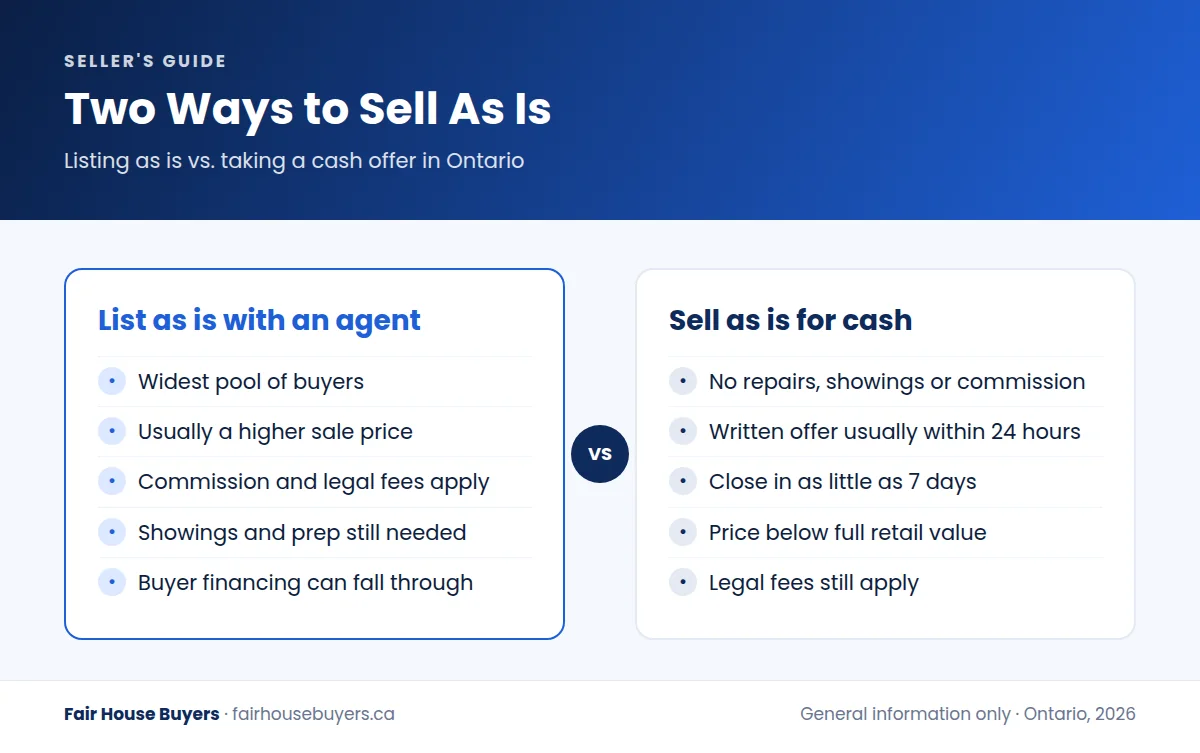
Your agent lists the home on MLS and flags it as an as-is sale. As a result, you reach the widest pool of buyers, including renovators and first-time buyers who want a project. You will still pay commission, which is negotiable, and you still need to prep for showings.
The catch is financing. Since many buyers need a mortgage, a lender may balk at a home with major problems. As a result, deals can fall apart after the inspection, and then you start over.
2. Sell as is to a cash buyer
A cash buyer, like Fair House Buyers, purchases homes in any condition. There are no showings, no repairs, and no commission. We usually give a written cash offer within 24 hours, and you can close in as little as 7 days or on the date you choose.
The trade-off is price. A cash offer is almost always below full retail value, because the buyer takes on the repairs, the risk and the resale costs. If you’re weighing that route, first read how to spot a legit cash home buyer.
3. Sell privately as is
You can also sell on your own and skip the agent. You save commission. But then you handle pricing, marketing, showings and negotiation yourself. In addition, you still need a real estate lawyer to close. Private as-is sales also tend to attract bargain hunters, so expect tough offers.
| Route | Typical price | Speed | Your effort | Best for |
|---|---|---|---|---|
| List as is with an agent | Higher, minus commission | Weeks to months | Showings, prep, deal risk | Homes with fair bones and flexible timing |
| Cash buyer | Lower, but no fees | As little as 7 days | Very low | Major repairs, tight deadlines, estates |
| Private sale | Varies widely | Unpredictable | High | Sellers with time and a buyer lined up |
Want to see your as-is number?
Tell us about your home and its condition. We’ll send a written, no-obligation cash offer, usually within 24 hours, so you can compare it with listing.
Get my cash offer →or call 905-497-5534
How much less will you get? The honest math
When you sell a house as is in Ontario, buyers discount it for two reasons. First, they must pay for the repairs. Second, they want a cushion for surprises, their time, and their risk. So the discount is often bigger than the repair bill alone.
Here’s a hypothetical example. Say you own a semi in Oshawa that would sell for $850,000 in great shape. It needs about $70,000 of work on the roof, basement and wiring. We’ll assume 4% commission plus 13% HST, $2,000 in legal fees, and $3,000 a month in carrying costs.
| Route | Sale price | Repairs | Commission + HST | Legal | Carrying costs | You net |
|---|---|---|---|---|---|---|
| Fix, then list (4 months) | $850,000 | −$70,000 | −$38,420 | −$2,000 | −$12,000 | $727,580 |
| List as is (3 months) | $760,000 | None | −$34,352 | −$2,000 | −$9,000 | $714,648 |
| Cash offer (2 weeks) | $700,000 | None | None | −$2,000 | Minimal | $698,000 |
In this example, fixing first nets about $29,600 more than the cash offer. But it only works if you have $70,000 on hand, four spare months, and the stomach for contractor delays. Of course, your own numbers will differ, and sometimes listing wins by a lot. You can also compare what it costs to sell in Ontario line by line before you decide.
When should you sell a house as is in Ontario?
Still, an as-is sale is not right for everyone. It tends to make sense when:
- Repairs cost more than you can afford or finance.
- You inherited the home and live far away, or the estate needs to settle quickly.
- The home has damage from fire, water or a long-term tenant.
- You face a deadline, such as a job move, divorce or mortgage trouble.
- You simply don’t want months of showings and contractors.
On the other hand, fixing and listing is often better when the problems are cosmetic, you have savings, and you’re not in a rush. In fact, paint, cleaning and small repairs often pay for themselves. Our guide to selling a damaged house in Toronto covers the tougher cases.
How to sell a house as is in Ontario: 5 steps
Know your home’s condition. Get a pre-listing inspection or repair quotes so you know what buyers will find.
Gather your disclosure facts. Write down every hidden problem you know about, plus past repairs and permits.
Price it for its real state. Compare recent sales of similar homes that needed work, not the renovated ones.
Choose your route. Weigh an as-is listing, a private sale, and a cash offer side by side.
Hire a real estate lawyer. Your lawyer reviews the as-is clause, handles title, and closes the deal.
Tip: Get more than one number
Before you decide, ask an agent for an as-is price opinion and get at least one cash offer. Then plug both into a net-proceeds comparison. The gap is often smaller, or bigger, than you expect.
Next step: get a clear as-is price
If you want to sell a house as is in Ontario, start with facts, not guesses. Know your repair costs, your disclosure duties, and your net from each route. Then pick the path that fits your time, budget and stress level, because the right answer is personal.
If speed and simplicity matter most, Fair House Buyers buys homes as is across the GTA and Ontario. You can learn how our process works, or request an offer below with no obligation.
This article is general information, not legal or tax advice. Talk to a real estate lawyer or accountant about your situation.
Frequently asked questions
Yes. You can sell a house as is in Ontario by adding an as-is clause to your agreement of purchase and sale. The buyer accepts the home in its current state, with no repairs or warranties from you. However, you must still disclose known latent defects, meaning hidden problems that make the home dangerous or unfit to live in.
It means the buyer takes the property in its current condition on closing day. The seller makes no repairs, gives no credits, and offers no promises about the roof, systems or appliances. The buyer can still inspect first. Because the buyer carries the repair risk, as-is homes usually sell for less than similar homes in good shape.
If you know about hidden water damage that could make the home unfit or unsafe, such as mould or a foundation leak, you should disclose it. RECO says sellers must reveal known latent defects. Visible stains are patent defects, but painting over them to hide them can make you liable. When unsure, disclose and ask a lawyer.
Usually not. Once the sale closes, repairs are the buyer’s job, especially in an as-is deal. The main exceptions are when the seller hid a problem, misstated facts, or failed to disclose a known latent defect. A buyer could then sue. Honest disclosure and a clear as-is clause are your best protection.