
Yes, you can sell it, but the estate trustee usually needs probate first. Selling an inherited house in Ontario normally means applying for a Certificate of Appointment of Estate Trustee, paying Estate Administration Tax, and then closing once the certificate arrives. Tax on the gain up to the date of death goes on the deceased’s final return.
If you’re sorting this out after losing someone, go easy on yourself. Very little has to happen this week. This guide covers selling an inherited house in Ontario from start to finish. You’ll learn who can sell, how probate shapes the timeline, what taxes apply, and the honest pros and cons of each option.
Key takeaways
- How the deceased held title decides the path: joint tenancy passes to the survivor, while other homes go through the estate.
- Most estates with real estate need probate before the transfer can register on title.
- You can often list and sign a deal before probate, but closing usually waits for the certificate.
- The deceased’s final return covers the gain up to death. Later growth is taxable to the estate or heirs.
- An estate trustee owes a duty to the beneficiaries, so get a proper valuation before you accept any offer.
Who can handle selling an inherited house in Ontario?
Before anything else, find out how the home was owned. Your lawyer can pull the title, and it usually settles the question fast. Ontario’s guide to co-ownership arrangements explains the two main types.
If the home was held in joint tenancy
With joint tenancy, the surviving owner gets the home automatically. Lawyers call this the right of survivorship. The house skips the estate, so the survivor can usually sell it without probate, once the lawyer updates title with the death certificate.
If the deceased owned it alone or as a tenant in common
In this case, the home or the deceased’s share goes into the estate. Then the estate trustee named in the will (often called the executor) has the power to sell it. Beneficiaries receive the money after the sale, but they don’t sign the deal themselves.
If there is no will, someone usually applies to court to become the estate trustee. Until then, nobody has clear authority to sell.
Probate: the first step in selling an inherited house
Probate is the court process that confirms the estate trustee’s authority. Ontario says estates that include real property normally need probate. The land registry also generally requires a Certificate of Appointment before an estate trustee can transfer the home, with a few narrow exceptions.
How long it takes depends on the court and on how complete the application is. So the timeline for selling an inherited house in Ontario often runs several months from start to finish.
Can you sell before probate?
Often, yes. An estate trustee can usually list the home and sign an agreement before the certificate arrives. However, closing usually waits until the certificate is in hand, because the buyer’s lawyer needs it to take clean title.
Tip: Protect your closing date
If you sign before probate, ask your lawyer to build in a flexible closing date. That way a slow court doesn’t put you in breach of the deal.
Estate Administration Tax
Ontario charges Estate Administration Tax when you apply for probate. It is $0 on the first $50,000 of the estate, then $15 for each $1,000 (or part of $1,000) above that.
| Estate value | Taxable portion | Estate Administration Tax |
|---|---|---|
| $50,000 | $0 | $0 |
| $500,000 | $450,000 | $6,750 |
| $900,000 | $850,000 | $12,750 |
| $1,200,000 | $1,150,000 | $17,250 |
For smaller estates worth $150,000 or less, Ontario offers a simpler small estate certificate. However, few GTA homes fall under that limit.
Taxes when selling an inherited house in Ontario
When someone dies, CRA treats them as if they sold everything at fair market value right before death. CRA calls this a deemed disposition. The gain up to that moment goes on the deceased’s final tax return.
Here is the good news. If the house was the deceased’s principal residence, the estate trustee can usually designate it on Form T1255, so that gain is often tax-free. Also, a home left to a surviving spouse can usually roll over without tax at death.
Growth after the date of death
For heirs selling an inherited house in Ontario, the starting cost is the fair market value at death. So only growth after that date is taxable, unless the home becomes your own principal residence.
Say your mother’s Scarborough bungalow was worth $1,000,000 when she passed. The estate sells it a year later and nets $1,040,000 after selling costs. That leaves a $40,000 gain, and half of it, or $20,000, is taxable. For more on this, read our guide to capital gains on a home sale in Ontario.
Watch out: Get a date-of-death appraisal
A written appraisal as of the date of death sets the tax cost for everyone. Without one, you may struggle to defend the numbers if CRA asks.
Can the house stay in the deceased person’s name?
Yes, for a while. Title often stays in the deceased’s name until the estate trustee sells or transfers it. But the bills keep coming, and the estate has to pay them.
- Property tax and utilities keep running, even in an empty home.
- Home insurance may change once the home is vacant, so tell the insurer right away.
- Mortgage payments still come due, and missed payments can lead to default.
- Upkeep matters too, because a burst pipe in January hurts the sale price.
Want a no-pressure number for the estate?
We can give you a written cash offer, usually within 24 hours, and close on the date that fits your probate timeline. No repairs, no cleanout and no showings.
Get my cash offer →or call 905-497-5534
Your options for selling an inherited house in Ontario
There is no single right answer. The best path depends on the home’s condition, how fast the estate needs cash, and whether the family agrees.
| Option | Best when | Trade-offs |
|---|---|---|
| List with an agent | The home shows well and the estate can wait | Usually the highest price, but commission, prep and showings |
| Sell as-is for cash | The home needs work or is full of belongings | Fast and simple, but usually below full market value |
| One heir buys out the others | A family member wants to keep the home | Needs an agreed value and financing |
| Keep and rent it | The heirs want long-term income | Landlord duties and future capital gains tax |
When selling an inherited house in Ontario as the estate trustee, you owe the beneficiaries a duty to act in their best interest. That usually means getting a proper valuation and keeping notes on why you chose an offer. Also, if the house needs major work, compare what repairs would really cost against an as-is sale. Our guide on how to sell a house as is in Ontario covers that math, and our cash offer vs. listing comparison shows the net side by side.
Steps for selling an inherited house in Ontario
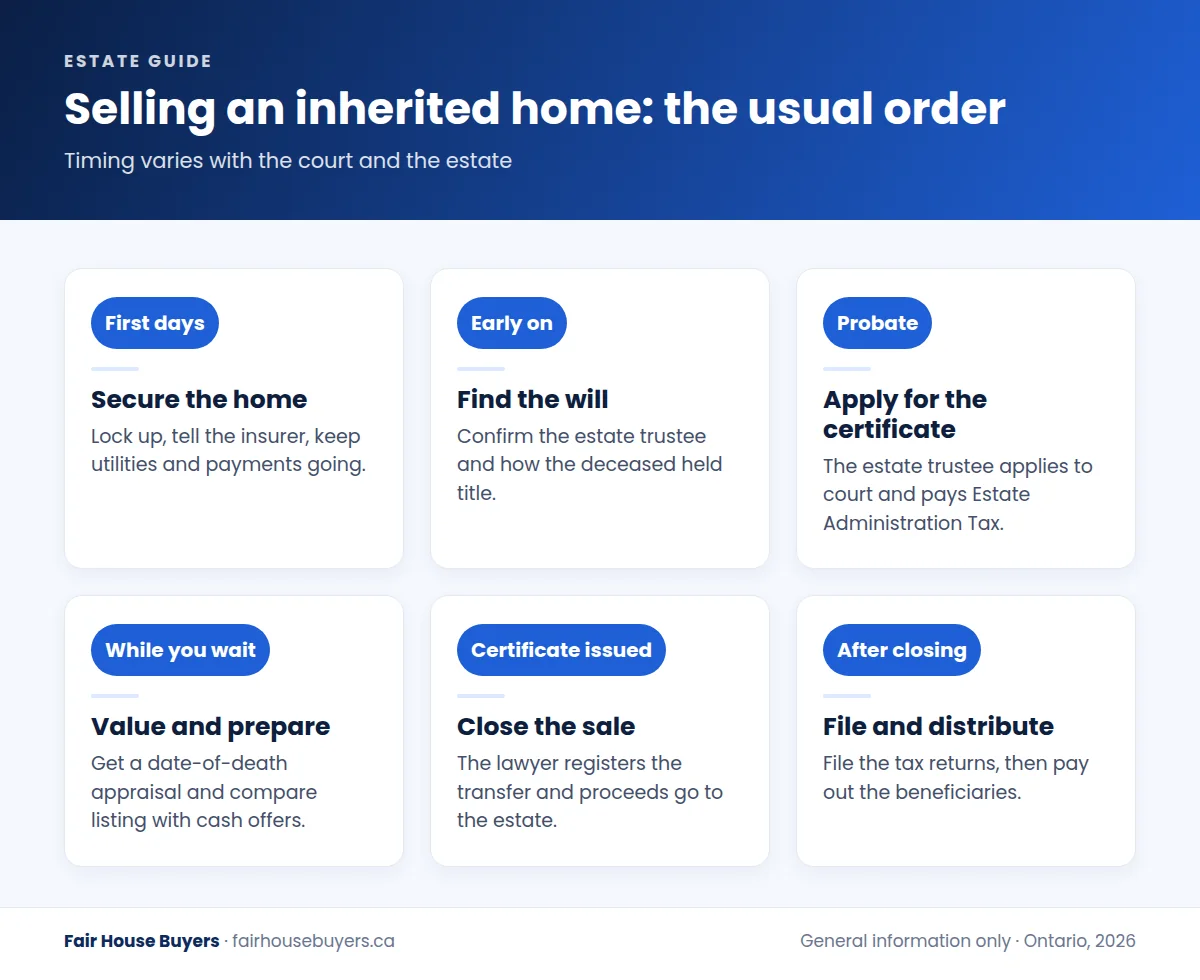
Secure the home. Lock up, tell the insurer, and keep utilities and mortgage payments current.
Find the will and check title. Confirm who the estate trustee is and how the deceased held the home.
Apply for probate. A lawyer can prepare the application and help you pay Estate Administration Tax.
Get a date-of-death appraisal. It sets the tax cost and gives you a fair benchmark for offers.
Choose how to sell. Compare listing and cash offers, then set a closing date after the certificate should arrive.
File returns, then distribute. Many estate trustees ask CRA for a clearance certificate before paying out beneficiaries.
When family members disagree
Disagreements are common, and they are hard when everyone is grieving. If the home sits in the estate, the estate trustee makes the call, although they must treat beneficiaries fairly. If heirs already own it together, any co-owner can ask a court to order a sale under Ontario’s Partition Act. Most families do better with a mediator first, since court adds cost and time.
This article is general information, not legal or tax advice. Talk to a real estate lawyer or accountant about your situation.
Frequently asked questions
Often, the estate trustee can list the home and sign an agreement of purchase and sale before probate. However, closing usually waits until the Certificate of Appointment of Estate Trustee arrives, because the land registry generally needs it to transfer title. The main exception is a home held in joint tenancy, which passes straight to the surviving owner.
Yes, title can stay in the deceased’s name for a while, often until the estate trustee sells or transfers it. Meanwhile, the estate still pays property tax, utilities, insurance and any mortgage. Tell the insurer the home is vacant, since coverage can change. Leaving it too long adds costs and risk, so most estates act within months.
At death, CRA treats the owner as selling the home at fair market value. That gain goes on the final return, but the principal residence exemption often covers it. After that, the estate or heir starts with a cost equal to the value at death. Only growth after death is taxable, with 50% of the gain counted as income.
You can’t always avoid it, but you can often keep it small. Get a date-of-death appraisal to lock in a fair starting cost. Selling fairly soon limits growth after death, and selling costs reduce the gain. If you move in and make the home your principal residence, future growth may qualify for the exemption. An accountant can confirm your numbers.