
How much do cash buyers pay for houses? There’s no fixed percentage, though. Most cash buyers pay below full market value, because they work backward from the home’s resale price and subtract repairs, costs and profit. A move-in-ready home may draw an offer fairly close to market value, while a home that needs major work will draw much less.
This guide shows the honest math, so you’ll see the formula investors use, a worked Ontario example, what pushes offers up or down, and how to tell if an offer is fair.
Key takeaways
- Cash buyers start with the after-repair value (ARV), then subtract repairs, costs and profit.
- Condition, location and timing drive the offer more than anything else.
- A lower offer can still be fair if it saves you commission, repairs and months of carrying costs.
- Compare your net from a cash sale with your net from listing, not the two prices.
- Get more than one offer, and have your lawyer review the terms.
How much do cash buyers pay? The short answer
How much cash buyers pay depends on who they are and what they plan to do. Renovators who fix and resell usually pay the least, because they carry the most risk. In contrast, landlords and builders may pay more for the right home. Meanwhile, a regular buyer with cash will often pay close to market value, but they’ll also expect a move-in-ready home.
The market matters too. The GTA had 4.6 months of inventory in August 2026, according to the TRREB Market Watch. So buyers are careful, and offers track today’s resale prices rather than 2022 peaks.
How cash buyers calculate an offer
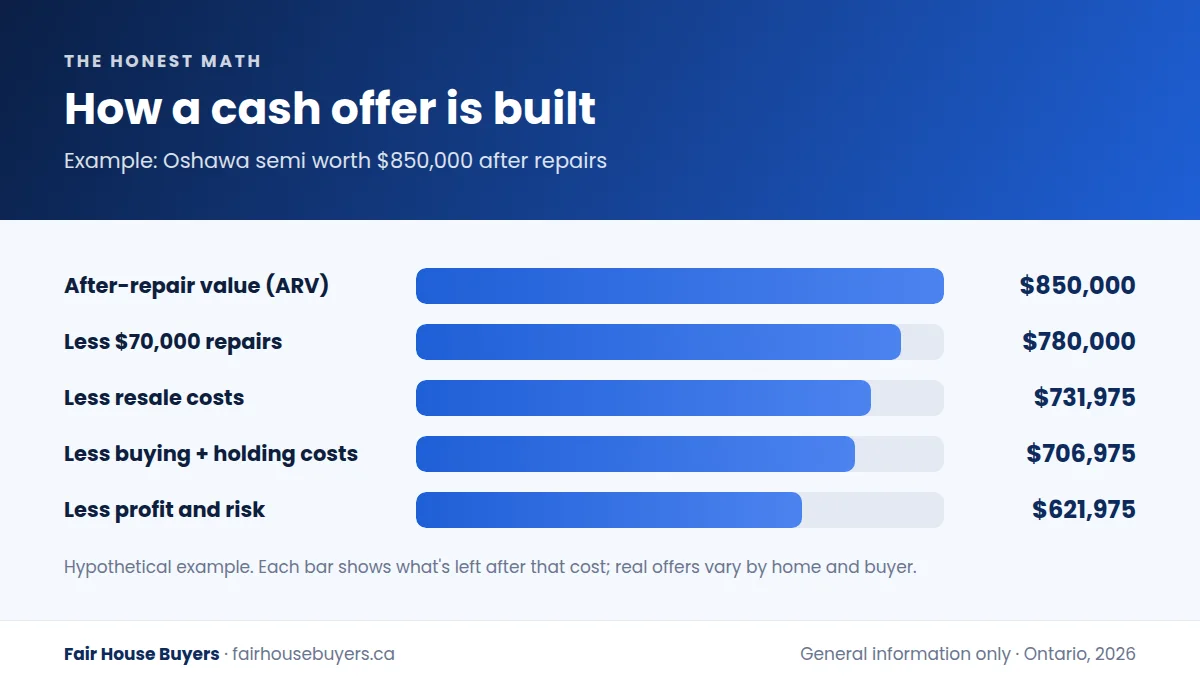
Most investors work backward from one number: the after-repair value, or ARV. In other words, it’s what the home should sell for once it’s fixed up, based on recent sales of similar homes nearby. From there, they take away every cost they expect to face.
The formula, step by step
Estimate the ARV. The buyer checks recent sales of similar, updated homes on your street or in your area.
Subtract repairs. They price the work, often with a contractor, and add a cushion for surprises.
Subtract resale costs. When they sell later, they’ll pay commission, HST and legal fees too.
Subtract buying and holding costs. This covers land transfer tax, legal fees, and the property tax, insurance, utilities and financing during the work.
Subtract profit and risk. Finally, they keep a margin that pays for their time, their capital and the chance that things go wrong.
What’s left is the most cash buyers can pay and still make the deal work. So if a buyer pays more than that number, they either expect a higher ARV or accept a thinner margin.
A worked example: what cash buyers pay for an Oshawa semi
For example, say you own a semi in Oshawa. Once fixed up, similar homes nearby sell for about $850,000. However, yours needs a new roof, a kitchen, a bathroom and some electrical work, which a contractor prices at $70,000.
| Step | Cost | What’s left |
|---|---|---|
| After-repair value | — | $850,000 |
| Repairs | −$70,000 | $780,000 |
| Resale costs (5% commission plus HST) | −$48,025 | $731,975 |
| Buying costs (land transfer tax, legal) | −$10,000 | $721,975 |
| Holding costs (5 months at $3,000) | −$15,000 | $706,975 |
| Profit and risk margin (10% of ARV) | −$85,000 | $621,975 |
In this example, the buyer can offer about $622,000, or roughly 73% of the ARV. Every number here is hypothetical, though. A different repair quote or profit target would move the offer up or down.
How that offer compares with fixing and listing
Next, look at it from your side. If you did the work yourself and listed, you’d net about $714,975 after repairs, commission, HST, $2,000 in legal fees and five months of carrying costs. With the cash offer, by contrast, you’d net about $619,975 after your own legal fees.
That’s a gap of $95,000, and we won’t pretend otherwise. Fixing and listing wins if you have $70,000 on hand, five months to manage contractors, and repairs that go to plan. By contrast, the cash offer wins on speed, certainty and zero work.
There’s also a middle path. You can sell the home as-is with an agent, since buyers will discount for the repairs but you skip the upfront cost. Before you spend on repairs, check which fixes are worth doing. Then compare all three routes with our side-by-side net proceeds guide.
What would you actually walk away with?
Our free Walk-Away Calculator also compares listing with a cash sale for your home, including commission, HST and carrying costs. You’ll also get a PDF report by email.
What makes cash buyers pay more or less
Two homes with the same ARV can draw very different offers. In particular, these factors move the number the most.
| Factor | Pushes the offer up | Pushes the offer down |
|---|---|---|
| Condition | Move-in ready, with updated systems | Roof, foundation, wiring or water damage |
| Location | Strong demand near transit and schools | Busy roads, weak demand or oversupply |
| Property type | Detached homes and semis in demand | Condos in crowded buildings |
| Season | Busy spring or early fall market | Slow winter market with high inventory |
| Tenants | Good tenants paying market rent | Arrears, disputes or below-market rent |
| Paperwork | Clear title and permits | Unpermitted work, liens or estate delays |
Hidden defects matter too. Ontario sellers must disclose latent defects that make a home dangerous or unfit, so it’s better to share known problems up front. Then the offer won’t change later.
Types of cash buyers and what each will pay
Not every cash buyer runs the same math. So here’s how the main groups tend to price homes.
- Flippers usually pay the least, because they need room for repairs, resale costs and profit.
- Landlords may pay more when the rent covers their costs, since they plan to hold for years.
- Builders pay for the land, so an old house on a big lot can draw a strong offer.
- Home-buying companies make quick as-is offers. Some fix, some rent, and some pass the contract to another investor, so offers vary.
- Everyday buyers with cash may pay close to market value, but they usually want a home that’s ready to move into.
The 70% rule: a rough benchmark
Many flippers use a shortcut called the 70% rule. It says to offer no more than 70% of the ARV, minus repairs. In our Oshawa example, that’s $595,000 minus $70,000, or $525,000.
However, that rule is popular in U.S. investor circles, where homes are often cheaper. In the GTA, many buyers use the full formula instead, because high prices change the math. So if an offer lands near the 70% line on a home that needs only light work, ask how they got there.
How to tell if a cash offer is fair
What cash buyers pay isn’t the only test of a fair offer. Instead, a fair offer is one you understand, that holds to closing, and that makes sense next to your other options.
- The buyer can show the recent sales behind their ARV.
- Their repair estimate lines up with what contractors tell you.
- You get it in writing, with a real deposit held in trust.
- Few conditions apply, and the closing date is firm.
- It sits in line with at least one other offer.
- Your net comes close enough to your listing net once you count time and risk.
Also check the buyer, not just the price. For example, our list of 11 red flags with cash buyers shows what to watch for. For the listing side, our Ontario selling cost breakdown helps you estimate commission and fees, and the Financial Consumer Agency of Canada lists the fixed costs every seller faces.
Tip: Ask for the math
A good buyer will walk you through their ARV, repair estimate and costs. If they won’t explain how they reached their number, treat that as a warning sign.
Condos: a special case in 2026
Condo cash offers face extra pressure right now, because supply is so high. Urbanation counted a record 5,001 completed but unsold new condos in the GTHA in Q2 2026. On top of that, resale condo prices per square foot in Q1 2026 were 25% below the Q1 2022 peak, according to Urbanation.
So cash buyers pay less for condos in crowded buildings, since they’d compete with all that supply when they resell. A listing may take longer too. Either way, base your plans on today’s prices, not the old highs.
If you’re weighing your options, our complete guide to selling for cash in Ontario walks through every step, from first call to closing day.
Frequently asked questions
There’s no set discount, since every home differs. A cash buyer prices each home around its after-repair value, repair costs, resale costs and profit margin. For a move-in-ready home, a cash offer may land fairly close to market value. For a home that needs major work, the offer will be much lower, because the buyer takes on the repairs, holding costs and resale risk.
No single company pays the most every time, because each one prices homes around its own plans and costs. A builder may pay more for a big lot, while a landlord may pay more for a home with good tenants. So get two or three written offers, then compare the price, deposit, conditions and closing date side by side.
Major defects usually hurt value the most. For example, these include foundation problems, an old roof, water damage, mould and outdated wiring. Unpermitted work, title problems and a poor location also drag the price down. In Ontario, you must disclose latent defects that make a home dangerous or unfit, so it’s best to share known problems early and price with them in mind.
That depends on your home and your goals. A cash offer is usually below full market value, but it removes commission, repairs, showings and the risk of a buyer’s financing falling through. If your home needs major work or you need a firm date, cash can be the better fit. If it’s move-in ready and you have time, listing often nets more.