
The hardest month to sell a house in Ontario is usually December or January. Fewer buyers are shopping, sales drop sharply, and prices tend to dip. In the GTA, January 2026 saw just 3,082 sales, while May saw 6,583, more than double. August can also be slow, since many buyers are on holiday.
That doesn’t mean you can’t sell in winter. It means you should price smart, prep well, and know your options. Below, we break down the 2026 TRREB numbers, the best and worst windows, and the honest math on waiting.
Key takeaways
- December and January are typically the slowest months for home sales in Ontario.
- GTA sales in May 2026 were about 2.1 times January’s, and the average price was about 10% higher.
- Spring (April to June) and early fall (September to October) are usually the strongest windows.
- Waiting for spring only pays if the price gain beats your carrying costs.
- Buyers in slow months tend to be serious, so a well-priced home can still sell.
What is the hardest month to sell a house in Ontario?
For most Ontario sellers, the answer is December, with January a close second. National sales tend to peak from March to May and bottom out in December, according to a Zoocasa analysis of Canadian home sales.
Toronto also follows a similar pattern. Local prices typically peak from April to June and again in September and October. In contrast, they’re usually lowest in December, January and August, as a study of Toronto price seasonality found.
What the 2026 TRREB data shows
The Toronto Regional Real Estate Board (TRREB) publishes sales every month. So we can compare the slowest and busiest months of 2026 so far.
3,082
GTA home sales in January 2026, average price $973,289 (TRREB)
6,583
GTA home sales in May 2026, average price $1,069,700 (TRREB)
5,057
GTA home sales in August 2026, average price $993,410 (TRREB)
In TRREB’s January 2026 report, the region logged 3,082 sales. By May, spring sales had climbed to 6,583. That’s about 2.1 times as many deals. Meanwhile, the average price rose from $973,289 to $1,069,700, a gap of $96,411, or about 10%.
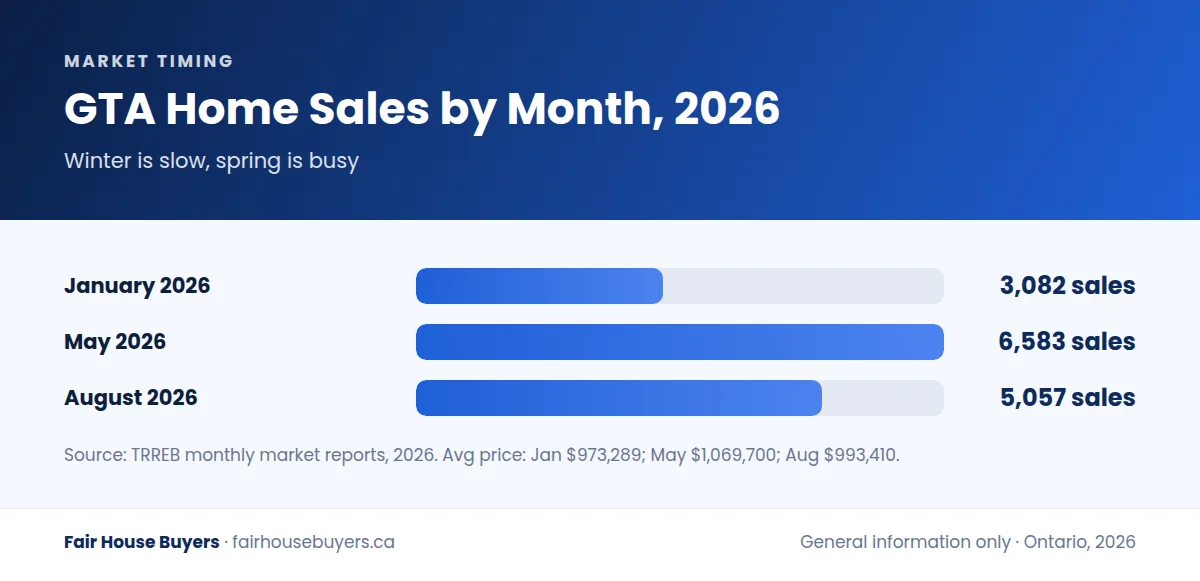
Good to know: Read averages with care
Part of that price gap comes from the mix of homes. More detached houses tend to sell in spring, which lifts the average. So your own home won’t necessarily be worth 10% less in January, but you’ll likely see fewer buyers.
Why winter is the hardest month to sell a house
Several things make winter the hardest month to sell a house, and they all pile up in December and January. Together, they shrink the pool of buyers and slow every step of the sale.
- Holidays and budgets. Families focus on travel, gifts and year-end bills instead of house hunting.
- School calendars. Parents prefer to move in summer, so they shop in spring rather than mid-year.
- Weather. Snow, ice and early darkness make showings harder, and curb appeal suffers.
- Fewer showings. Less traffic means fewer offers, so bidding wars are rare.
- Longer time on market. A home that sits can look “stale,” and buyers then push for a lower price.
August has a milder version of the same problem. Many buyers are at the cottage or on vacation. As a result, activity often dips before picking up again in September.
The best month to sell a house in Ontario
In general, spring is the strongest season, especially April through June. Buyers are out in force, and gardens look good. Plus, families want to move before the new school year starts. Early fall, from September to October, is often the second-best window.
| Season | Buyer activity | What it means for you |
|---|---|---|
| January–February | Low, but slowly rising | Serious buyers, fewer rival listings, softer prices |
| March–June | Highest of the year | Most offers and best odds of top dollar |
| July–August | Moderate, dips in August | Holidays slow showings; price carefully |
| September–October | Strong second peak | Good window before the holidays |
| November–December | Falling to the low point | Hardest time; expect longer days on market |
Right now, it’s late September 2026, so sellers are in the fall window. Still, the market looks fairly balanced, with 4.6 months of inventory in TRREB’s August 2026 Market Watch. Buyers have choices, so pricing matters more than timing alone.
Sell now or wait for spring?
Our free Walk-Away Calculator compares your net from listing with a cash sale. Run it with today’s numbers before you decide to wait.
Should you wait for spring? The honest math
Waiting feels safe, but it isn’t free. Every month you hold the home, you also pay the mortgage, property tax, insurance, utilities and upkeep.
Here’s a hypothetical example. Say your carrying costs are $3,500 a month, and you decide in December to wait until April. That’s four months, or $14,000. Spring needs to add more than $14,000 to your net price, after the extra commission, just to break even.
For some homes, that works out. For others, however, it doesn’t, especially if the market softens in the meantime. Also, if you’re moving for work or settling an estate, you may not have four months to spare.
When waiting makes sense, and when it doesn’t
Waiting for spring tends to pay off when:
- Your home shows best with green grass and long days.
- You have no deadline and can easily cover the carrying costs.
- Your own move lines up better with a spring or summer date.
On the other hand, selling now often makes more sense when:
- You’re paying for two homes, or your mortgage renewal is coming up at a higher rate.
- The home needs work you can’t afford, so spring buyers would discount it anyway.
- You’re settling an estate or moving for a job and need a firm date.
How to sell a house in the hardest month
Even if you must sell a house in the hardest month of the year, you can still do well. Use these steps to stand out while other sellers wait.
Price it right on day one. In a slow month, an overpriced home sits. Start near market value to draw early offers.
Make it warm and bright. Turn on every light, keep the heat comfortable, and clear snow and ice from every path.
Use photos from warmer months. Include a summer shot of the yard or garden if you have one.
Fix only what matters. Handle safety issues and leaks, and skip costly upgrades. Also, our guide on which repairs to skip before listing can help.
Be flexible on dates. Offer a closing date that suits the buyer, such as a spring move-in.
Tip: Winter buyers mean business
People who shop in January often have a reason, such as a new job or a lease ending. That urgency can work in your favour if your home is ready and fairly priced.
When the month doesn’t matter at all
For a cash buyer, the hardest month to sell a house is just another month. Snow, school calendars and the holidays don’t change the offer. Fair House Buyers buys homes as is, all year. You’ll usually get a written cash offer within 24 hours, and you can close in as little as 7 days or on the date you choose.
That said, a cash offer is usually below full retail value, whatever the season. It makes the most sense when speed, certainty or the home’s condition matter more than squeezing out the top price. To see how buyers build offers, read how much cash buyers really pay, and compare it with listing with a realtor.
Next step: time your sale on purpose
The hardest month to sell a house is not a dead end. If you can wait, spring and early fall usually bring the most buyers. But if you can’t, strong pricing and good prep can still get you a fair deal in winter.
Either way, start with your real numbers first. Know your carrying costs, your likely price, and your deadline, and then choose the path that fits.
Frequently asked questions
In Ontario, the hardest month to sell a house is usually December, followed closely by January. Buyer traffic drops over the holidays, and winter weather makes showings harder. In the GTA, January 2026 had 3,082 sales compared with 6,583 in May. August can also be slow because many buyers are away on vacation.
So far, 2026 has been soft. In August 2026, TRREB’s average GTA price was $993,410, down 2.7% from a year earlier, and the benchmark price was down 4.5%. The Bank of Canada held its rate at 2.25% in September. Since nobody can predict prices with certainty, plan around your own needs and timeline.
For a home in good shape, listing with an agent in spring or early fall usually brings the highest price. However, profit means your net after commission, repairs, and carrying costs. If your home needs major work or you’re short on time, a cash sale can sometimes net close to the same with less risk. Compare both before you decide.
It depends on your goals. A cash offer is faster and more certain, with no showings, repairs or financing conditions. But it is usually below full retail value. If you have time and a well-kept home, listing often nets more. If speed, the home’s condition, or a deadline matter most, cash can be the better fit.