
“Should I sell my house now or wait?” For most Ontario owners in fall 2026, your needs matter more than market timing. Prices are soft but steady: TRREB’s August average was $993,410, down 2.7% in a year. Sell your house now if carrying costs or a renewal squeeze you, and wait if you have no deadline.
Nobody can promise where prices go next. But you can look at the real data, weigh your costs, and decide with clear eyes. This guide covers the fall 2026 numbers, the case for each choice, and the math on waiting.
Key takeaways
- GTA prices dipped slightly over the past year, while new listings fell 14.1%, so supply is tightening.
- The Bank of Canada held its key rate at 2.25% in September, and its next decision is October 28, 2026.
- Fall is often a strong season, since Toronto prices tend to peak in spring and again in September and October.
- Before you decide to sell your house now or wait, compare likely price gains with what it costs to hold the home.
- If a renewal or carrying costs are stretching you, act early while you still have choices.
The Ontario market right now: fall 2026
Before you choose to sell your house now or wait, it helps to know where things stood at the end of summer.
$993,410
average GTA sale price, down 2.7% year over year (TRREB, Aug 2026)
4.6 months
of inventory in the GTA (TRREB, Aug 2026)
−14.1%
drop in new GTA listings year over year (TRREB, Aug 2026)
2.25%
Bank of Canada policy rate, held on Sept 2, 2026
In August 2026, the GTA logged 5,057 sales, down 2.1% from a year earlier, according to TRREB’s August 2026 market report. The benchmark price fell 4.5%. Meanwhile, new listings dropped 14.1%, which means fewer homes are competing for each buyer.
Active listings also fell 11.3% to 24,482. So the market looks fairly balanced, with 4.6 months of inventory and homes averaging 35 days on market, as TRREB’s Market Watch data shows. In short, buyers have choices, but they’re not in total control.
The national picture is similar. CREA reported that August sales fell 6.9% year over year across Canada, with 4.8 months of inventory. On rates, the Bank of Canada held its policy rate at 2.25% on September 2, and its next decision comes on October 28.
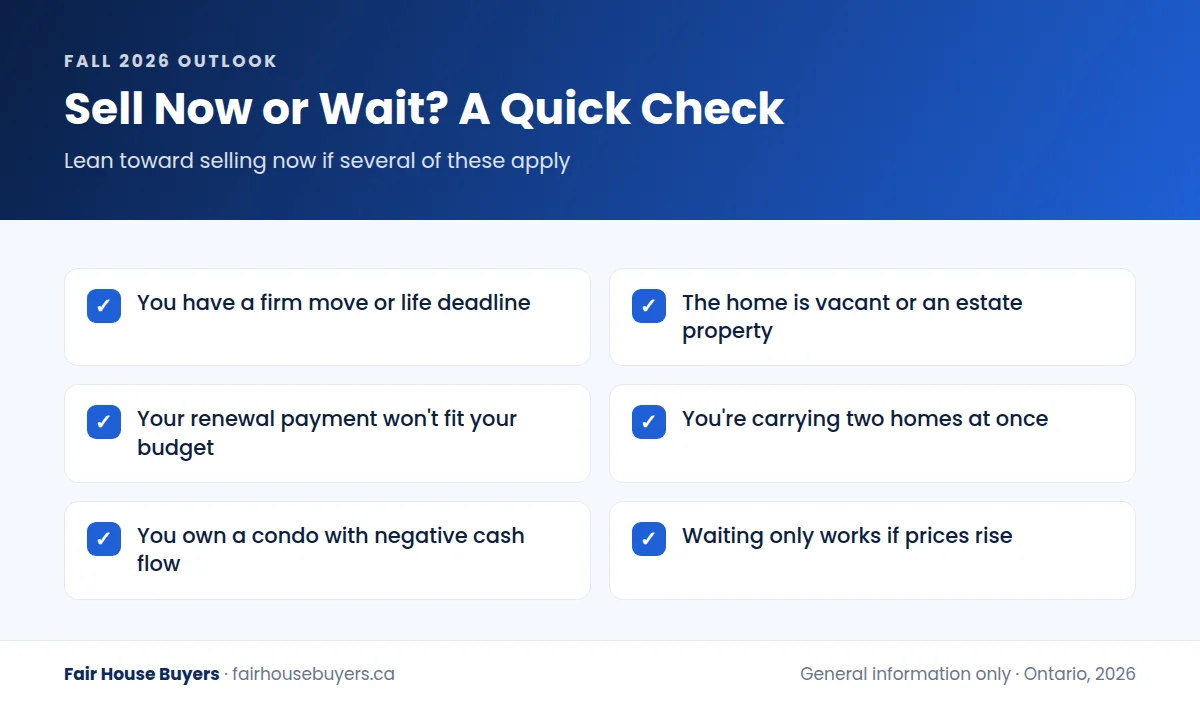
Should I sell my house now or wait? 5 questions to ask
The market sets the backdrop. However, your own situation should decide whether you sell your house now or wait. Start with these questions.
Do I have a deadline? A job move, a divorce, or an estate often sets the timeline for you.
What does it cost me to hold the home each month? Count interest, property tax, insurance, utilities and upkeep.
Is my mortgage renewal coming up? A higher payment at renewal can change the math quickly.
Where will I live next? Buying and selling in the same market can soften the effect of price swings.
Can I handle more uncertainty? Waiting means betting on prices, rates and your own finances.
Reasons to sell my house now
Selling this fall can make sense for several reasons, especially when life is pushing you to move.
- You’re in a good season. Toronto prices tend to peak from April to June and again in September and October, according to a Toronto seasonality study. After that, December and January are usually the slowest.
- Less competition. With new listings down 14.1% year over year, your home faces fewer rivals than it did last fall.
- Carrying costs add up. If you’re paying for a vacant home, an estate property, or two homes at once, each month costs you money.
- A renewal is looming. Selling before a big payment jump can protect your equity and your credit.
- Life won’t wait. Divorce, relocation, health or family changes often matter more than a few percent on price.
Reasons to wait before you sell your house
On the other hand, it can be smarter to wait than to sell your house now. Waiting tends to work when:
- You have no deadline and can easily afford your payments.
- You’d live in the home anyway, so holding it doesn’t add an extra cost.
- Your home shows best in spring, such as a house with a great garden. In 2026, GTA sales in May were about 2.1 times January’s.
- You want to watch rates. The next Bank of Canada decision lands on October 28. Still, no one can promise a cut.
Also, there’s no tax deadline pushing you to sell. The federal government cancelled the proposed capital gains increase in March 2025, so the inclusion rate stays at 50%. For most people selling a principal residence, the gain is tax-free anyway, as long as you report the sale.
Run your own now-or-later numbers
Our free Walk-Away Calculator compares what you’d net from listing with a cash sale. Enter your price and costs, then get a PDF report by email.
The cost of waiting: a simple example
If you can’t decide whether to sell your house now or wait, put a price on waiting. It’s not free if you’re holding a home you don’t need. So let’s run hypothetical numbers.
Say you own a $900,000 home in Vaughan that you’ve already moved out of. Holding it costs $4,000 a month in interest, property tax, insurance, utilities and upkeep. You’re thinking about waiting six months, which costs $24,000.
| Scenario in six months | Price change | Holding costs | Better or worse than selling now |
|---|---|---|---|
| Prices fall 3% | −$27,000 | −$24,000 | $51,000 worse |
| Prices stay flat | $0 | −$24,000 | $24,000 worse |
| Prices rise 3% | +$27,000 | −$24,000 | $3,000 better |
In this example, prices would need to rise about 2.7% just to break even. That’s before the small extra commission on a higher price. However, if you’d live in the home anyway, the math changes, because you’d pay for housing either way.
Good to know: Nobody can time the market
Forecasts miss all the time. Instead of guessing the bottom or the top, pick a plan that still works if prices go the “wrong” way for a while.
Facing renewal? Don’t wait too long to decide
Many Ontario owners are renewing at higher rates. The Bank of Canada’s May 2026 Financial Stability Report says the last pandemic-era five-year fixed mortgages, about 12% of all mortgages, renew over the next 12 months. Those payments rise about 15% on average. It also notes that arrears are rising among Toronto-area borrowers who bought in 2022 and 2023.
CMHC data tells a similar story. Toronto’s mortgage arrears rate climbed from 0.076% in Q3 2023 to 0.261% in Q3 2025, and CMHC forecasts 0.34% by the end of 2026.
If your renewal payment won’t fit your budget, talk to your lender early. Waiting until you miss payments shrinks your options. Our guide on what happens after missed mortgage payments explains the timeline.
Condo owners: a special case
Condos face more pressure than houses right now. In Q2 2026, the GTA had a record 5,001 completed but unsold new condos, up 68% from a year earlier, according to Urbanation. Resale condo prices per square foot were also down 25% from their early 2022 peak.
So if you own a condo, a quick rebound is less certain. That doesn’t mean you must sell your house or condo now, but it’s a reason to be cautious before you wait for a big recovery.
| Your situation | Leans toward |
|---|---|
| Vacant home, estate or second property | Selling sooner |
| Renewal payment you can’t afford | Selling sooner, or talking to your lender now |
| Condo investor with negative cash flow | Selling sooner |
| Living there with a comfortable payment | Waiting is fine |
| Home that shows best in spring, no deadline | Waiting may pay |
Is now a good time to sell my house?
It can be, if your reasons are strong and your price is realistic. The fall window, lower competition from new listings, and steady rates all help sellers. Still, the benchmark price is down 4.5% year over year, so pricing to today’s market matters.
If you need speed or certainty, a cash sale is another option. Fair House Buyers buys homes as is, usually with a written offer within 24 hours, and you can close in as little as 7 days or on your date. That said, a cash offer is usually below full retail value. So compare it against listing, using our guide to cash offers vs. listing with a realtor.
Next step: decide whether to sell your house now or wait
Start with your deadline, your monthly holding cost, and your renewal date. Then compare your net from selling this fall with a realistic spring scenario. If you’d only wait because you hope prices rise, it may be safer to sell your house now.
When you’re ready, see how our process works or run the numbers with our calculator. Either way, you’ll decide with facts, not fear.
This article is general information, not legal or tax advice. Talk to a real estate lawyer or accountant about your situation.
Frequently asked questions
So far, 2026 has been soft. TRREB’s August 2026 average GTA price was $993,410, down 2.7% from a year earlier, and the benchmark price was down 4.5%. However, new listings fell 14.1%, which could support prices. The Bank of Canada held its rate at 2.25% in September. No one can predict prices with certainty.
In Ontario, December is usually the hardest month to sell, with January close behind. Fewer buyers shop over the holidays, and winter makes showings harder. In the GTA, January 2026 had 3,082 sales, while May had 6,583. If you’re choosing between now and winter, fall is usually the stronger window.
If the home was your principal residence every year you owned it, the gain is usually tax-free. However, you must still report the sale on your tax return. For rentals or second homes, half of the capital gain is taxable. Homes owned less than a year may face the flipping rule. Talk to an accountant about your situation.
For a well-kept home with no deadline, listing with an agent in spring or early fall usually brings the highest price. But profit means your net after commission, repairs and holding costs. If your home needs work or you’re carrying two properties, a faster sale can sometimes net nearly as much. Whether you sell your house now or wait for spring, compare your options side by side.