
Yes, but if you’re married, you usually need your spouse’s consent. Under Ontario’s Family Law Act, neither married spouse can sell the matrimonial home without the other’s written consent, a separation agreement, or a court order. Selling a house during divorce in Ontario works differently for common-law couples, whose rights mostly follow whose name is on title.
Separation is hard enough without a house decision hanging over it. So this guide keeps things practical: your rights, your options, the money questions, and the steps that keep the sale from turning into another fight.
Key takeaways
- Married spouses both have an equal right to live in the matrimonial home, no matter whose name is on title.
- A married spouse can’t sell or mortgage that home without consent, a separation agreement, or a court order.
- Common-law partners don’t get those special home rights. Ownership follows title.
- If you can’t agree, a co-owner can ask a court to order a sale under the Partition Act.
- Your principal residence is usually tax-free, and separation is an exception to the 365-day flipping rule.
Your rights when selling a house during divorce in Ontario
It all starts with one question: are you legally married, or common-law? Ontario’s family property rules treat the two very differently.
Married spouses and the matrimonial home
The Family Law Act gives both married spouses an equal right to possession of the matrimonial home (section 19). That’s true even if only one of you is on title.
Also, section 21 says neither spouse can sell or mortgage the home without one of three things. You need the other spouse’s consent, a separation agreement that releases the right, or a court order. So if you’re married, selling a house during divorce in Ontario always involves both of you in some way.
Common-law partners
These matrimonial home rules apply to married spouses only. For common-law couples, the person on title generally controls the home. If you own it together, you both have to sign to sell. If your partner owns it alone, you may still have a claim, but you’ll need a lawyer to assert it.
| Question | Married spouses | Common-law partners |
|---|---|---|
| Right to live in the home? | Equal right for both, whoever is on title | Generally follows title |
| Can one sell alone? | No, without consent, agreement or court order | A sole owner generally can |
| If joint owners disagree? | Either can go to court | Either can ask for a Partition Act sale |
Can your spouse force a house sale during divorce?
Not on their own, if you’re married. But either of you can ask a judge to decide. Under section 2 of the Partition Act, a co-owner can ask the court to order a sale.
A judge looks at the full picture, including children and any claim for exclusive possession. As a result, the timing and outcome depend on your facts. Going to court also costs money and months, so most couples settle the house question in a separation agreement instead.
Options for selling a house during divorce in Ontario
Most couples choose from four paths. Each one has a real trade-off, so talk them through with your lawyer before you commit.
| Option | Good fit when | Watch out for |
|---|---|---|
| List with an agent | You can cooperate on showings and price | Commission, prep, and months of joint decisions |
| One spouse buys out the other | One of you wants to stay, often for the kids | The buyer must qualify for the mortgage alone |
| Keep co-owning for now | You want the kids to finish the school year | You stay tied together on the mortgage |
| Sell as-is for cash | You want a clean, fast break with no showings | Price is usually below full market value |
A listing usually brings the highest price when the home shows well and you can work together. That said, living together through showings and price cuts is hard for some couples. Our cash offer vs. listing guide shows how to compare the real net of each path.
How a spousal buyout works
A buyout lets one of you keep the home instead of selling the house during divorce in Ontario. First, you agree on the home’s value. Then you subtract the mortgage to find the equity, and the spouse who stays usually pays out the other’s share.
Say your Whitby detached is worth $1,000,000 and the mortgage balance is $400,000. That leaves $600,000 in equity, so a half share is $300,000. To fund it, the staying spouse might refinance to about $700,000, which covers the old $400,000 mortgage plus the $300,000 payout. Equalization and other debts can shift that number, so run it past your lawyers.
Need a number you can both look at?
We can give you a written, no-obligation cash offer, usually within 24 hours. You can close in as little as 7 days or on the date your agreement sets.
Get my cash offer →or call 905-497-5534
Money questions when selling a house during divorce
The joint mortgage
If you both signed the mortgage, you both stay responsible until it’s paid off, even after one of you moves out. So keep paying it, because missed payments hurt both credit files. When you sell, your lender may charge a prepayment penalty. The FCAC explains how to reduce or avoid prepayment penalties, for example by porting.
Capital gains tax
If the home was your principal residence, the gain is usually tax-free. Also, CRA’s 365-day flipping rule has an exception for separation lasting at least 90 days, according to CRA’s principal residence rules. You still must report the sale. Our guide to capital gains on a home sale explains the reporting.
Splitting the proceeds
Proceeds often go into the real estate lawyer’s trust account until your separation agreement or a court order says how to divide them. For married couples, the home also plays a special role in equalization. Generally, if you owned the home on your wedding day and it’s still the matrimonial home, you can’t deduct its wedding-day value.
Steps for selling a house during divorce in Ontario
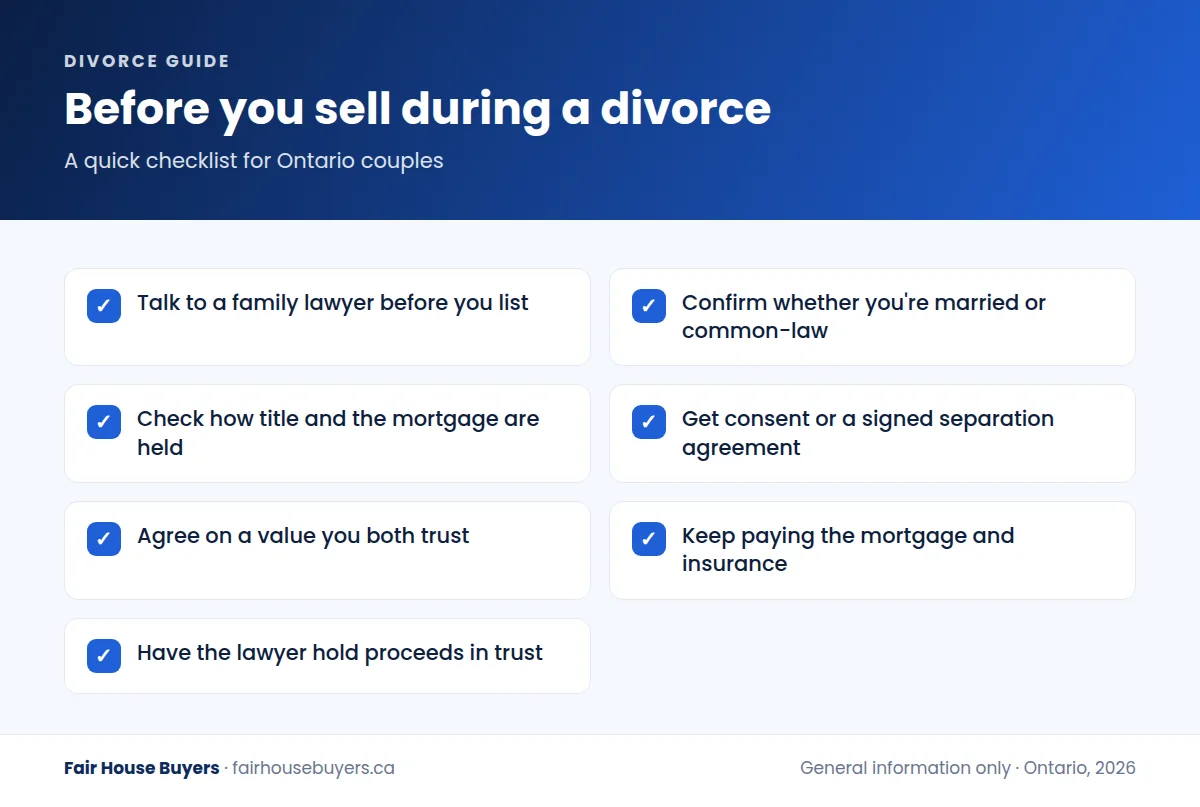
Get your own legal advice. Each spouse should talk to a family lawyer before listing or signing anything.
Agree in writing. Settle who picks the agent or buyer, the price range, and who pays carrying costs until closing.
Get a value you both trust. A professional appraisal or a few agent opinions keep the price discussion calm.
Pick your sale path. Compare a listing, a buyout and a cash sale on real net proceeds.
Both sign the deal. The lawyer then holds proceeds in trust until your agreement or order says how to split them.
What not to do during a separation or divorce in Ontario
A few moves can backfire badly when you are selling a house during divorce in Ontario. Family lawyers commonly warn against these:
- Listing or selling without consent. For married spouses, section 21 makes that off-limits.
- Changing the locks on your spouse. Both married spouses have an equal right to possession unless a court or agreement says otherwise.
- Stopping mortgage payments. Arrears hurt you both and can lead to a forced sale.
- Hiding or draining assets. Courts expect full financial disclosure from both sides.
Watch out: Your safety comes first
If you don’t feel safe at home, call 911 in an emergency. Then ask a family lawyer about exclusive possession of the home.
Once you’ve agreed on a plan, selling a house during divorce in Ontario can move fast. A cash buyer can often close in days rather than months, while a mortgage-financed buyer usually needs longer. Our guide on closing timelines in Ontario compares both.
This article is general information, not legal or tax advice. Talk to a real estate lawyer or accountant about your situation.
Frequently asked questions
Not on his own. Under the Family Law Act, a married spouse can’t sell the matrimonial home without the other’s consent, a separation agreement, or a court order. However, he can ask a judge to order a sale, for example under the Partition Act. The judge looks at the whole situation, including children, so outcomes vary. Many couples settle it in a separation agreement.
If you’re married, you can’t sell or mortgage the matrimonial home without your spouse’s consent, an agreement or a court order. You also shouldn’t lock out a spouse who has an equal right to live there. Keep paying joint debts like the mortgage, and don’t hide or drain assets. When in doubt, talk to a family lawyer first.
In a regular sale, the seller pays their own real estate lawyer, and the buyer pays theirs. In a divorce, couples often pay the sale’s legal fees from the proceeds before splitting them. Each spouse usually pays their own family lawyer separately. Your separation agreement can set out exactly how you’ll share these costs.
A cash buyer doesn’t need mortgage approval, so a sale can close quickly once both sides sign. Fair House Buyers can close in as little as 7 days, or on the date you choose. When selling a house during divorce in Ontario, that flexibility helps you match the closing date to your separation agreement, a school year, or a new lease.