Usually not. If the home was your principal residence for every year you owned it, you owe no tax on capital gains when selling a house in Ontario. The principal residence exemption covers the full profit. But you must still report the sale to CRA, and rentals, cottages and quick flips follow different rules.
This guide explains how capital gains work when selling a house in Ontario, when you pay tax, and how to report the sale so you keep your exemption. We use plain numbers and real CRA rules, so you can see where you stand before you talk to an accountant.
Key takeaways
- Your own home is usually tax-free when you sell, thanks to the principal residence exemption.
- You still must report the sale on Schedule 3 and Form T2091(IND), or CRA can deny the exemption.
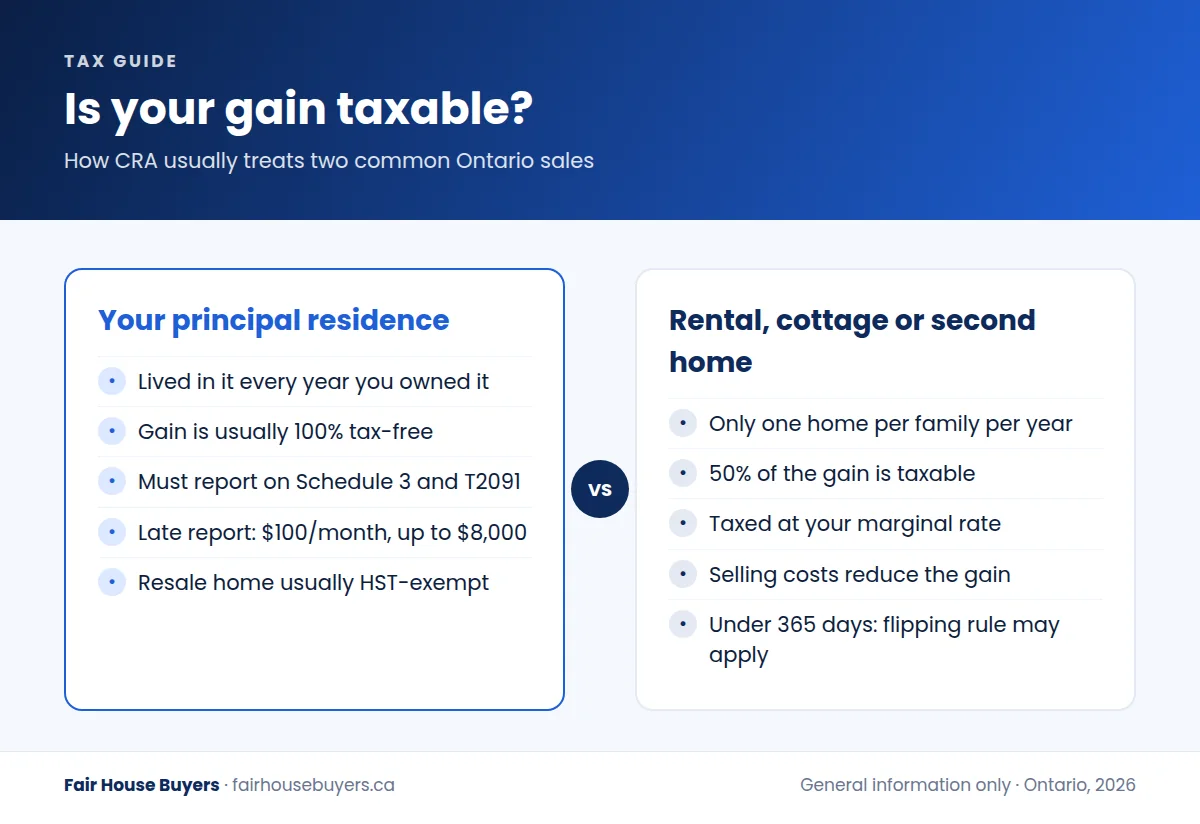
- Rentals, cottages and second homes are taxable. Half of the gain gets added to your income.
- Sell a home within 365 days and the flipping rule can make 100% of the profit taxable.
- Selling for cash does not change the tax. CRA looks at your price and your costs, not the buyer.
How capital gains tax works when selling a house in Ontario
A capital gain is your profit on the sale. In simple terms, you take the selling price, then subtract your selling costs and your adjusted cost base. Your adjusted cost base is what you paid for the home plus certain costs, such as land transfer tax, legal fees on the purchase, and major improvements.
Next comes the inclusion rate. Only half of a capital gain counts as taxable income in Canada. The federal government cancelled the proposed increase to that rate in March 2025, so the rate stays at 50%.
That taxable half then gets added to your other income for the year. So the real tax bill depends on your marginal rate, not on a flat “capital gains rate.” CRA’s T4037 capital gains guide walks through the full calculation.
A simple example with a Hamilton rental
Say you own a rental townhouse in Hamilton and sell it for $950,000. Your selling costs, such as commission and legal fees, come to $30,000. Your adjusted cost base is $520,000.
| Line | Amount |
|---|---|
| Selling price | $950,000 |
| Minus selling costs | −$30,000 |
| Minus adjusted cost base | −$520,000 |
| Capital gain | $400,000 |
| Taxable at 50% inclusion | $200,000 |
In this example, $200,000 lands on your tax return as income. Because that is a big jump for one year, much of it could fall into Ontario’s top tax brackets. That is why planning the timing matters.
The principal residence exemption: why most homeowners pay nothing
The principal residence exemption is the reason most Ontario families never pay tax on their home. According to CRA’s principal residence rules, your gain is fully tax-free if the home was your principal residence for every year you owned it. For most people, that makes capital gains on selling a house a non-issue.
To qualify, a few things need to be true:
- You, your spouse or partner, or your child ordinarily lived in the home during the year.
- Your family unit claims only one principal residence per year.
- You bought the home to live in, not mainly to resell it for profit.
Your family unit means you, your spouse or common-law partner, and your minor unmarried children. So if you own a Toronto semi and a Muskoka cottage, only one of them can shelter capital gains for any given year.
The “plus one” rule
CRA’s formula adds one bonus year to the years you designate. As a result, you don’t lose the exemption in a year when you sell one home and buy the next. It also softens the blow if a home qualified for most, but not all, of the years you owned it.
Good to know: Renting out your basement
CRA generally lets you keep the full exemption when you rent part of your home, as long as the rental is small compared to your own use. You also need to avoid structural changes and skip claiming depreciation (capital cost allowance) on the home.
You must still report the sale to CRA
This is the step people miss. Since the 2016 tax year, you must report the sale of your principal residence on Schedule 3 and Form T2091(IND). CRA only allows the exemption if you report it.
If you forget, you can still ask CRA to accept a late designation. However, CRA can charge a penalty of $100 for each full month it is late, up to a maximum of $8,000.
Watch out: CRA is watching real estate
CRA runs a dedicated real estate compliance program. Every sale since 2016 must appear on your return, even when you owe nothing.
When you pay capital gains tax on selling a house
So when do you actually owe tax on capital gains from selling a house? Here are the most common Ontario situations and how CRA usually treats each one.
| Your situation | Tax on the gain? | What to know |
|---|---|---|
| Your home, every year you owned it | Usually no | Report it on Schedule 3 and T2091(IND) |
| Rental property | Yes | 50% of the gain is taxable income |
| Cottage or second home | Often yes | Only one home per family unit per year |
| Home you lived in only some years | Partly | The formula taxes the years that don’t qualify |
| Home owned under 365 days | Often yes, as business income | Flipping rule, unless an exception applies |
| Inherited house | Depends | Tax on growth since the date of death |
The 365-day flipping rule
For sales since January 1, 2023, CRA treats profit on a home you owned for less than 365 days as business income. That means 100% of it is taxable, and the principal residence exemption does not apply.
However, the rule has exceptions for real life events. These include:
- A death, or a new member joining your household
- Separation from a spouse or partner for at least 90 days
- A threat to your safety, or a serious illness or disability
- A move for work or school that brings you at least 40 km closer
- Involuntary job loss or insolvency
- Destruction or expropriation of the home
Capital gains after selling an inherited house
When someone dies, CRA treats them as if they sold everything right before death at fair market value. CRA calls this a deemed disposition. Your cost as the heir then starts at that value, so you are only on the hook for growth after the date of death. Our page on how to sell an inherited house in Toronto covers the practical side.
See what you'd actually walk away with
Compare listing with an agent against a cash sale, side by side. You get a free PDF report with commission, legal fees and your net proceeds.
How to lower capital gains when selling a house
If you owe tax on capital gains from selling a house, a few legal moves can shrink the bill. Most of them come down to good records and good timing.
Track your adjusted cost base. Add land transfer tax, purchase legal fees, and major improvements like a new roof or addition. Routine repairs don’t count.
Subtract every selling cost. Commission, legal fees and similar outlays reduce your gain. See our breakdown of the cost to sell a home in Ontario.
Designate the right home. If your family owns two homes, an accountant can help you pick the one with the higher gain per year.
Use past capital losses. Net capital losses from earlier years can offset this year’s taxable gain.
Plan the closing date. A closing in January instead of December moves the gain into a different tax year.
Does selling a house for cash change capital gains?
No. The tax on capital gains from selling a house is the same whether you list on MLS or sell to a cash buyer. CRA cares about your proceeds, your costs and how you used the home.
Also, the sale of a used home you lived in is usually exempt from HST. So a cash sale doesn’t add HST for a typical homeowner either.
That said, be honest with yourself about the trade-off. A cash offer is usually below full market value, and a lower price means a smaller gain. But it also means less money in your pocket, so never pick a buyer just to save tax. Instead, compare your real net with each option. Our guide on how to sell your home for cash in Ontario explains when a cash sale makes sense.
This article is general information, not legal or tax advice. Talk to a real estate lawyer or accountant about your situation.
Frequently asked questions
Usually not, if it was your principal residence for every year you owned it. The principal residence exemption covers the full gain. You still must report the sale on Schedule 3 and Form T2091(IND). If the home was a rental, cottage or second property, or you owned it for less than 365 days, part or all of the profit can be taxable.
For most homeowners selling the home they live in, the tax is zero. On a rental or cottage, half of the capital gain gets added to your income and taxed at your marginal rate. For example, a $400,000 gain means $200,000 of taxable income. A resale home you lived in is also usually exempt from HST.
Yes. Since the 2016 tax year, you must report the sale of your principal residence on your tax return, even when you owe nothing. You do this on Schedule 3 and Form T2091(IND). If you miss it, CRA can accept a late designation but may charge $100 per full month, up to $8,000.
Property sales in Ontario are registered on title, so they leave a public record. CRA also runs a dedicated real estate compliance program that looks for unreported sales and wrongly claimed exemptions. The safest move is simple: report every sale on your return, even when you expect to owe no tax at all.